Dog boots earn their keep the moment the weather turns extreme or a paw gets sore: they shield pads from scorching pavement in summer, from grit, ice and rock salt in winter, and from re-injury while a cut or torn pad heals. Our top pick is the QKURT 4 Pieces Dog Boots — waterproof, reflective, washable and the best all-rounder here.
Below are five sets covering every job: an everyday all-rounder, a tall boot for winter and gritted roads, a breathable pair for hot-weather walks, a rugged option for hikes and rough ground, and soft grip socks for injured paws, senior dogs and slippery floors. There’s also a plain-English guide to knowing when your dog actually needs boots, how to measure, how to get a fit that won’t ping off, and how to get a reluctant dog wearing them happily.
Key Takeaways
- Best overall: the QKURT 4 Pieces Dog Boots — waterproof, reflective and washable, and the most-reviewed proper boot in this guide.
- Best for winter, ice & gritted roads: the Anti-Slip High Dog Boots — a tall boot that keeps snow, slush and rock salt out.
- Best for hot pavement & summer: the Faankiton Dog Boots for Hot Weather — breathable uppers with a heat-shielding sole.
- Best for hikes & rough terrain: the Eyein Dog Boots — dual adjustable straps that hold firm over uneven ground.
- Best for injured paws & indoor grip: the DOK TigerToes Non-Slip Dog Socks — soft grip socks trusted by more than 12,000 owners.
- Do the seven-second test before summer walks: if you can’t hold the back of your hand on the tarmac for seven seconds, it’s too hot for paws.
- Rock salt cracks and irritates pads and is toxic if licked off — rinse paws after winter walks, or boot up.
The 5 Best Dog Boots UK
1. QKURT 4 Pieces Dog Boots Paw Protector
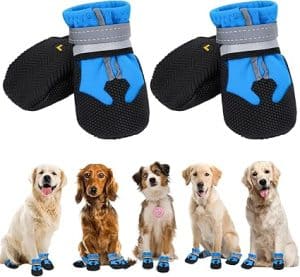
With more than 1,700 reviews, the QKURT set is the most-reviewed proper boot in this guide and the one we’d point most owners to first. It covers the full range of jobs a dog boot is bought for: a waterproof upper for wet grass and puddles, a non-slip rubber sole for traction, and reflective straps that pick up car headlights on dark evenings.
Two adjustable hook-and-loop straps per boot are the reason it stays on. Dog boots live or die on fit, and a single flimsy strap is the classic way to lose one down the road; the twin-strap design cinches above the widest part of the paw so the boot doesn’t twist or slide off mid-walk. The whole set is machine-washable, which matters more than you’d think once muddy autumn arrives.
It’s also the best value here for a four-boot set, which makes the volume of positive feedback all the more reassuring. As with any boot, measure your dog’s paws before ordering (see our sizing section below) — that single step is what separates owners who love these from the handful who don’t.
- Most-reviewed boot in this guide — proven all-rounder
- Waterproof upper with non-slip rubber sole
- Twin adjustable straps keep the boots on
- Reflective detailing and fully washable
- Sizing runs snug — measure carefully before ordering
2. Anti-Slip High Dog Boots
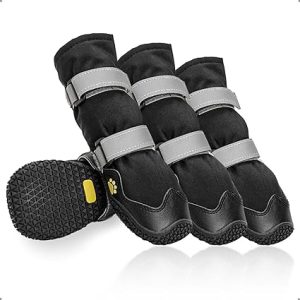
Winter is when boots stop being a nice-to-have. Gritted roads and pavements are coated in rock salt, which dries out, cracks and irritates paw pads — and, because dogs lick their feet, it’s toxic if enough is ingested. Ice and compacted snow do their own damage. This tall boot is built for exactly that: a higher shaft than most rivals means snow, slush and grit stay out rather than working their way inside.
The upper is a wear-resistant faux leather with a chunky rubber sole that grips frozen ground, and reflective straps help enormously on those pitch-black winter walks. Two straps hold each boot securely so they cope with a dog high-stepping through snow. For dogs that feel the cold generally, boots pair naturally with a good coat — worth a read of our guide on whether dogs get cold.
If your dog does pick up rock salt on an un-booted walk, wipe or rinse the paws afterwards — our piece on whether salt is bad for dogs explains why. The one caveat with a taller boot is that a few dogs need a little longer to get used to the extra coverage around the ankle, so introduce them gradually.
- Tall shaft keeps snow, slush and rock salt out
- Wear-resistant upper with a grippy rubber sole
- Reflective straps for dark winter walks
- Twin straps hold firm in deep snow
- Taller cut takes some dogs a little longer to accept
3. Faankiton Dog Boots for Hot Weather
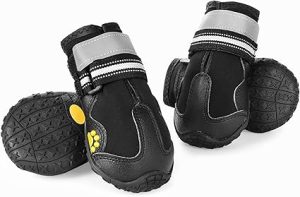
Hot pavement is one of summer’s most under-appreciated dangers. On a warm day tarmac can reach temperatures that burn pads in seconds, and dogs won’t always show pain until the damage is done. The PDSA and Dogs Trust both recommend the back-of-the-hand test — if you can’t comfortably hold your hand on the ground for seven seconds, it’s too hot to walk on. When you still need to get from A to B, these breathable boots let you do it safely.
Designed specifically for warm weather, the uppers use a breathable mesh-style fabric so paws don’t overheat inside the boot, while the sole shields against hot pavement, sand and grit. Adjustable reflective straps keep them secure, and they’re light enough that most dogs barely notice them once they’ve adjusted.
For the hottest days, boots are only part of the answer — walk early or late, carry water, and give your dog somewhere to cool off, such as one of the picks in our best dog cooling mats guide. Stock on this pair can be limited, so it’s worth grabbing them before the first heatwave rather than during it.
- Breathable uppers designed to stop paws overheating
- Sole shields against hot pavement, sand and grit
- Lightweight — easy for dogs to accept
- Adjustable reflective straps for a secure fit
- Popular in summer, so stock can run low
4. Eyein Dog Boots Paw Protector
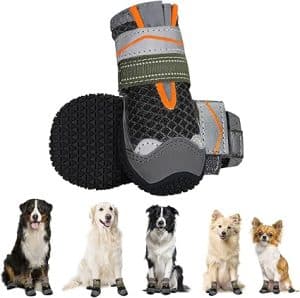
Rough ground is where a poorly-fitting boot gives up — a boot that stays put on the pavement can twist off the first time a dog scrambles up a rocky path or through a muddy field. The Eyein boots earn their place here for their dual adjustable straps, which lock in above and below the ankle so the boot follows the paw over uneven terrain instead of rotating loose.
They’re breathable, which is a genuine advantage on longer walks where a fully sealed boot would leave paws hot and sweaty, and the non-slip sole gives confident grip on trails, gravel and wet rock. The upper resists knocks from stones and stubble that would scuff a dog’s pads raw over a long hike.
These are best thought of as a protective walking boot for rugged conditions rather than a fully waterproof wader — deep bogs and streams will find their way in. But for the everyday hills-and-fields walks most active dogs actually do, they hit a sensible balance of protection, grip and breathability. As always, acclimatise your dog on short walks before a big day out.
- Dual straps keep boots on over rough ground
- Breathable — good for longer walks and hikes
- Non-slip sole grips trails, gravel and wet rock
- Tough upper resists stones and stubble
- Breathable design isn’t fully waterproof in deep water
5. DOK TigerToes Non-Slip Dog Socks
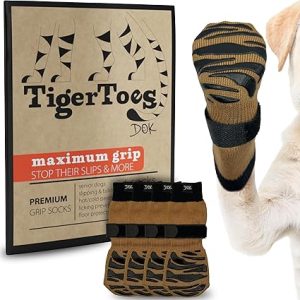
Not every paw problem calls for a rigid boot. For a healing wound, a dog that won’t stop licking a sore paw, or a senior slipping on laminate and tiles, soft grip socks are often the kinder answer — and with over 12,000 reviews, the DOK TigerToes are comfortably the most trusted pick in this whole guide. The extra-thick silicone grip pattern keeps working even if the sock twists, which is the usual failing of cheaper dog socks.
Indoors, they give anxious or arthritic dogs the traction to get up off a slippery floor without their legs splaying — a small change that makes a real difference to mobility and confidence. They also stop paws being licked raw and keep a light dressing clean, which is why owners of post-op and injured dogs rate them so highly.
A sensible caveat: socks manage a problem, they don’t diagnose it. If your dog is limping, licking obsessively, or has a wound that isn’t healing, see your vet first — supporting the paw while it recovers is exactly the sort of aftercare covered in our guide to keeping your dog healthy. For grip, comfort and gentle protection, though, these are hard to beat.
- Over 12,000 reviews — the most trusted pick here
- Extra-thick grip that keeps working even when twisted
- Great for senior dogs on slippery floors
- Protects healing paws and stops licking
- Socks, not boots — not for wet or rough outdoor walks
How to Choose Dog Boots
When does a dog actually need boots?
There are five situations where boots genuinely help. First, hot pavement in summer — do the seven-second back-of-the-hand test the PDSA and Dogs Trust recommend, and boot up (or change your route and timing) if the ground’s too hot. Second, gritted and salted winter roads, where rock salt cracks and irritates pads and is toxic if licked off. Third, injured or healing paws that need protecting from dirt and re-injury. Fourth, hiking and rough terrain that would scuff pads raw. And fifth, grip for senior dogs, or those with mobility problems, sliding around on hard indoor floors. If none of those apply, most dogs are perfectly happy barefoot — boots aren’t an everyday essential for every dog.
How to measure your dog’s paws
Correct sizing is the single biggest factor in whether boots work. Measure one paw at a time: pop a piece of paper on the floor, have your dog stand normally so the paw takes their weight and spreads slightly, and mark the widest points across the paw. That width is the number that matters — most sizing charts are built around paw width, not length. Measure the front paws and back paws, as they often differ, and if your dog falls between sizes, size up. Never guess from your dog’s weight or breed alone; two Labradors can take different boot sizes.
Getting a fit that won’t fall off
The number one complaint about dog boots is boots that ping off mid-walk, and it’s almost always a fit or fastening issue. Look for two adjustable straps rather than one, positioned to cinch above the widest part of the paw and around the ankle, and tighten them more firmly than feels necessary — snug but not so tight it restricts circulation. A boot that’s the right width but too loose at the ankle will always work its way off, so the strap is doing the real job.
Acclimatising your dog to boots
Almost every dog does the funny high-stepping “moon walk” the first time they wear boots — that’s normal and passes quickly. Take it in stages: put the boots on indoors for a few minutes at a time, pair them with treats and praise, then a little play, then a short garden potter, and only then a proper walk. A few sessions over a few days is usually all it takes. Rushing straight to a full walk is the fastest way to convince a dog they hate boots.
A note on injured paws
Boots and socks are excellent for protecting a paw while it heals, but they aren’t a substitute for veterinary care. If your dog has a deep cut, a torn or bleeding pad, persistent limping, swelling, or a wound that won’t close, see your vet before relying on a boot to cover it. Once your vet is happy the paw is on the mend, a clean, well-fitting boot or sock is one of the best ways to keep dirt out and stop your dog licking the area.
Frequently Asked Questions
Do dogs really need boots, or is it a gimmick?
For everyday mild-weather walks, most dogs don’t need boots. But in genuine extremes — scorching pavement, gritted winter roads, ice, rough hiking trails — or for injured paws and slippery indoor floors, they prevent real harm. Think of them as specialist kit for specific conditions rather than a permanent fashion item.
How hot is too hot for a dog’s paws?
Use the seven-second test: press the back of your hand to the pavement and hold it there. If you can’t keep it there comfortably for seven seconds, it’s too hot for your dog’s pads. On warm days tarmac is often far hotter than the air temperature, so test the actual surface, not the forecast.
Is rock salt from gritted roads dangerous to dogs?
Yes. Rock salt dries out and cracks paw pads, and because dogs lick their feet, swallowing enough can make them unwell. Either use boots on gritted routes, or wash and dry your dog’s paws thoroughly as soon as you get home to remove any residue.
How do I stop dog boots falling off?
Get the size right first — measure paw width and size up if you’re between sizes — then choose a boot with two adjustable straps and fasten them snugly above the widest part of the paw and around the ankle. Loose ankle straps are the usual reason boots come off.
Can boots help an old dog that slips on the floor?
Yes, though soft grip socks like the DOK TigerToes are often the better choice indoors. The rubberised grip gives arthritic and senior dogs the traction to stand and walk on laminate, tiles and wood without their legs sliding out from under them.
Our Verdict
For most dogs and most situations, the QKURT 4 Pieces Dog Boots are the best all-round choice in the UK — waterproof, reflective, washable and secured by twin straps that actually keep them on. Winter walkers on gritted roads should go for the taller Anti-Slip High Dog Boots, while summer heat calls for the breathable Faankiton hot-weather boots.
Hikers and active dogs will get on best with the rugged Eyein boots, and for injured paws, senior mobility or slippery floors the soft DOK TigerToes socks are the gentle, sensible option. Whichever you choose, measure carefully, introduce them slowly, and — for anything that looks like a real injury — check with your vet first. If cold weather is your main worry, it’s also worth pairing boots with one of the picks in our best dog coats guide to keep the whole dog warm, not just the paws.