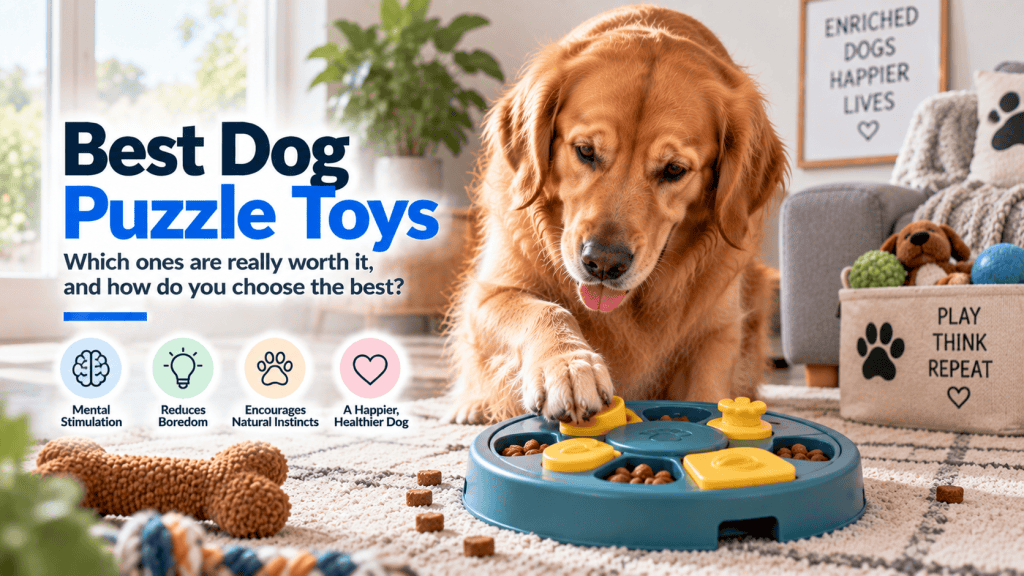
A bored dog is a destructive dog — I learned that the hard way with a chewed skirting board and a shredded cushion in my early days of ownership. Puzzle toys turned that around for us. Ten or fifteen minutes of working out how to get a treat out of a puzzle tires a dog out more than a decent walk sometimes, and it’s brilliant on rainy days when you’re stuck indoors.
The trick is picking the right difficulty and something sturdy enough to survive a determined dog. I’ve tried a fair few over the years, so below are the five I’d genuinely recommend, from an easy starter puzzle right up to one that’ll challenge the cleverest dog in the room.
My top pick is the Nina Ottosson Level 2 Interactive Dog Puzzle. It’s the one I reach for most — a perfectly judged medium difficulty that suits the majority of dogs, built like a tank, and made by the brand that basically invented this category. It’s the safest bet if you’re only buying one.
Key Takeaways
- Best overall: Nina Ottosson Level 2 — the ideal medium-difficulty puzzle for most dogs.
- Best for beginners: Nina Ottosson Level 1 — simple, cheap and confidence-building.
- Best for clever dogs: Nina Ottosson Level 4 — a proper brain-teaser for puzzle pros.
- Best for puppies: Amazon Basics Hide-and-Seek Plush — gentle, plush hide-and-seek fun.
- Best value: LUKITO Slow Feeder Puzzle — great all-rounder that won’t break the bank.
The 5 Best Dog Puzzle Toys
1. Nina Ottosson Level 2 Interactive Dog Puzzle — Best Overall
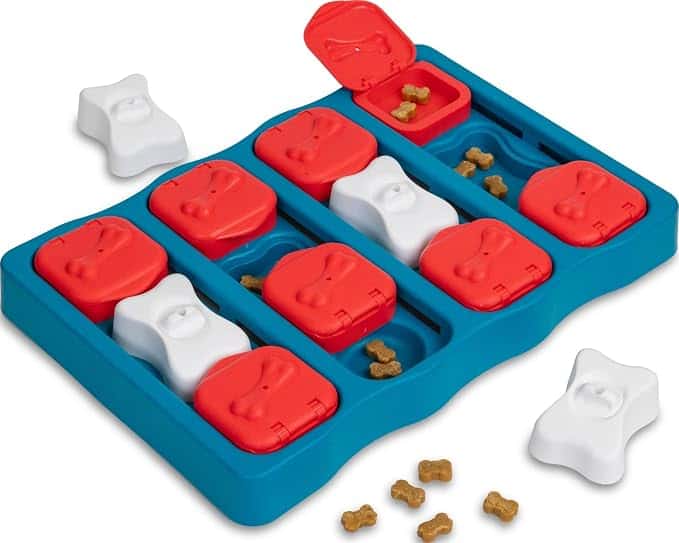
If you only buy one puzzle toy, make it this one. Nina Ottosson (sold here under the Outward Hound name) is the brand that set the standard for dog puzzles, and the Level 2 is their Goldilocks option — not too easy, not too hard, just right for the average dog. You hide treats in the compartments, your dog nudges and paws the sliders and flaps to reveal them, and before long they’re properly engaged.
What sold me is how well made it is. It’s a solid, chunky bit of kit that stands up to enthusiastic pawing, wipes clean easily, and doesn’t slide all over the kitchen floor. My dogs took to it quickly but it still keeps them thinking for a good while, which is exactly the balance I want. It’s earned an enormous following among UK owners, and I completely understand why.
The one thing to watch is that it’s not a chew toy — it’s an activity you supervise, then put away. A determined chewer left alone with it could damage the sliders. Used as intended, though, it’s the puzzle I’d recommend to almost anyone.
Pros
- Perfectly judged medium difficulty for most dogs
- Extremely well made and easy to clean
- From the brand that pioneered dog puzzles
- Non-slip base stays put on the floor
Cons
- Not a chew toy — needs supervising, not leaving out
2. Nina Ottosson Level 1 Interactive Dog Puzzle — Best for Beginners
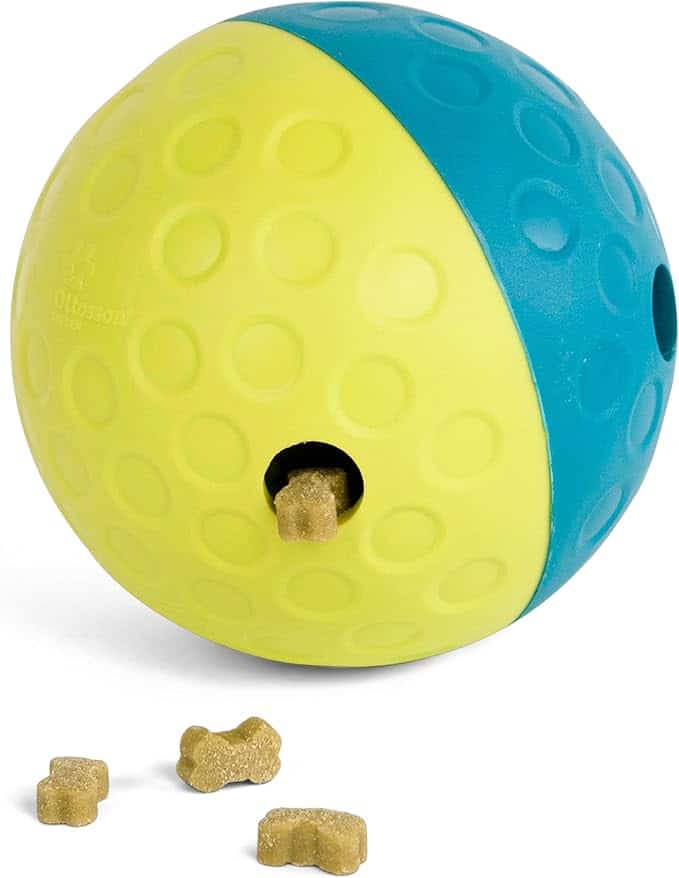
If your dog has never seen a puzzle toy before, don’t throw them in at the deep end — start here. The Level 1 is the same quality build as my top pick but with simpler mechanics, so a beginner can succeed quickly and build the confidence to keep trying. Nothing puts a dog off a puzzle faster than one that’s too hard from the off, and this one avoids that trap nicely.
It’s also the cheapest option on my list, which makes it an easy, low-risk way to find out whether your dog even enjoys this kind of thing. Mine cracked it within a couple of sessions, and rather than getting bored, they went looking for the next challenge — which is exactly what you want a starter puzzle to do.
The obvious flip side is that a clever or experienced dog will solve it almost instantly and want more. That’s not really a fault — it’s a beginner toy doing its job — but if your dog is already a puzzle veteran, size up.
Pros
- Ideal simple starter for first-time puzzlers
- Cheapest option — low-risk way to test the waters
- Same solid Nina Ottosson build quality
- Builds confidence before moving up levels
Cons
- Too easy for clever or experienced dogs
3. Nina Ottosson Level 4 Advanced Puzzle — Best for Clever Dogs
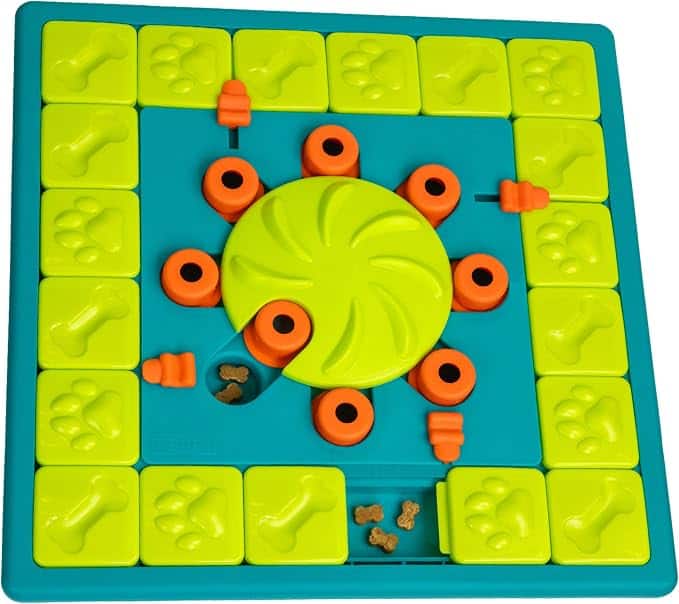
Some dogs are just annoyingly clever — mine has a Collie streak and will crack a medium puzzle in seconds — and for those brainboxes you need the Level 4. This is the top of Nina Ottosson’s difficulty ladder, with multiple steps that have to be solved in sequence: slide this, then lift that, then flip the other to finally reach the treat. It genuinely makes them think.
I love watching a smart dog properly problem-solve on this one, and it buys you far more quiet time than an easier puzzle ever would. If your dog has outgrown everything else and is tearing through simpler toys, this is the natural next step and a real workout for their brain.
Two honest caveats: it’s the priciest here, and because it’s tough, some dogs get frustrated and give up if they haven’t worked up through the easier levels first. I’d only recommend it for confident, experienced puzzlers — otherwise you’re setting them up to fail.
Pros
- Genuinely challenging multi-step puzzle
- Perfect for clever, experienced dogs
- Buys plenty of quiet problem-solving time
- Excellent mental workout
Cons
- Priciest here, and can frustrate inexperienced dogs
4. Amazon Basics Hide-and-Seek Plush Puzzle — Best for Puppies
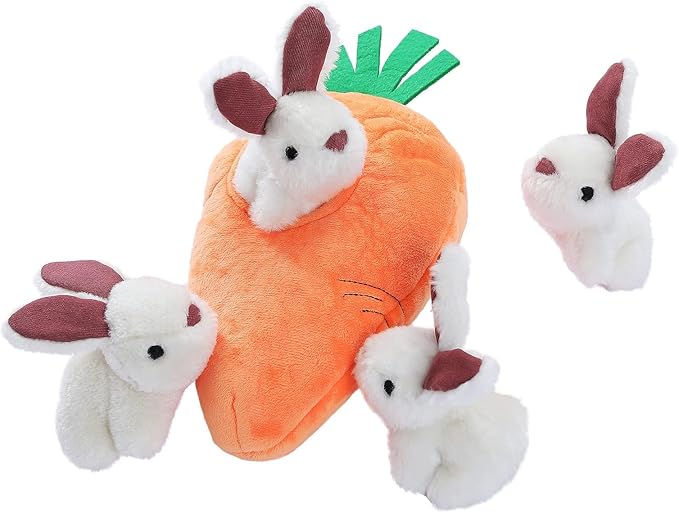
Not every dog gets on with hard plastic puzzles, and puppies in particular often prefer something soft they can also carry around and mouth. This plush hide-and-seek set is my pick for them — little carrot toys (or bunnies) tucked into a soft holder that your dog has to pull out one by one. It’s a gentler, cuddlier take on the puzzle idea and a lovely first enrichment toy.
I like that it works on two levels: there’s the puzzle of extracting the pieces, and then the pieces themselves become squeaky toys for a game of fetch or a chew. That versatility makes it great value, and puppies especially seem to adore the softness. It’s the highest-rated toy on my list for good reason.
Being plush, it’s not built for heavy chewers — a strong-jawed adult will eventually pull the stuffing out, so supervise and step up to a tougher toy once they’re older. As a puppy or small-dog puzzle, though, it’s charming and clever.
Pros
- Soft, gentle puzzle perfect for puppies
- Pieces double as squeaky fetch toys
- Great value multi-piece set
- Top-rated and widely loved
Cons
- Not for heavy chewers — plush won’t survive strong jaws
5. LUKITO Slow Feeder Puzzle — Best Value
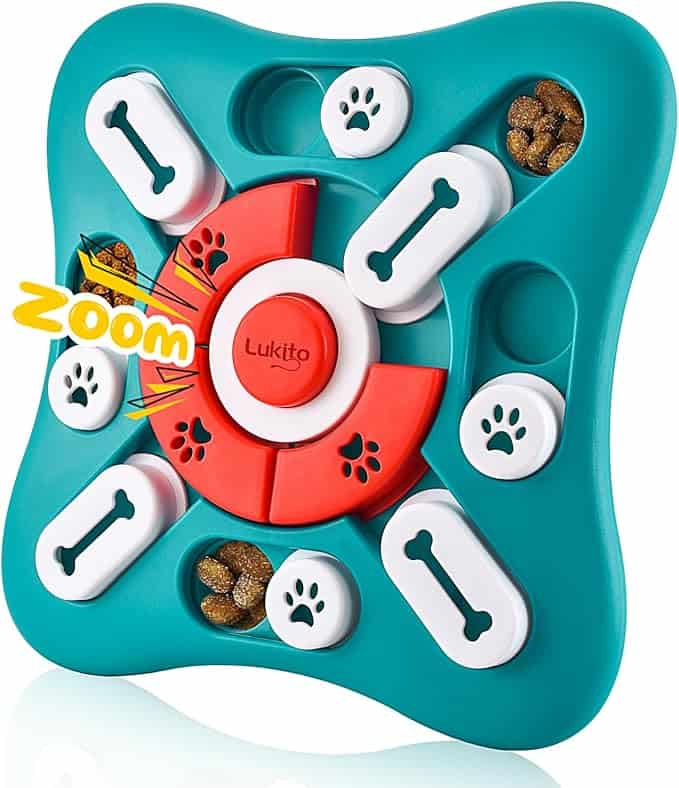
If you want to try a proper puzzle without spending much, the LUKITO is a genuinely good budget all-rounder. It combines a treat puzzle with a slow-feeder bowl, so it doubles up nicely — you can use it for enrichment sessions and also to slow down a dog that inhales its dinner. For the money, that’s a lot of usefulness in one toy.
The compartments and sliding covers give a satisfying medium challenge, and I’ve found it a handy second puzzle to rotate in so my dogs don’t get bored of the same old thing. It also comes up well in the wash, which matters when you’re hiding food in it every day. For a value pick it punches above its weight.
It’s not quite as heavy-duty as the Nina Ottosson toys — the plastic feels a touch lighter — so it’s best kept for supervised play rather than left with a serious chewer. But as an affordable, do-a-bit-of-everything puzzle, it’s hard to fault.
Pros
- Great value — puzzle and slow feeder in one
- Handy for slowing down fast eaters
- Satisfying medium challenge
- Easy to clean
Cons
- Lighter build than premium puzzles — supervise chewers
How to Choose a Dog Puzzle Toy
Start at the right difficulty
Matching the puzzle to your dog’s experience is the single most important thing. A puzzle that’s too hard leads to frustration and a dog that gives up; one that’s too easy gets solved and abandoned in seconds. If in doubt, start easier than you think and work up — most brands, Nina Ottosson included, use a clear level system to help.
Consider the material
Hard plastic puzzles are durable and easy to clean, ideal for interactive sessions. Plush puzzles are gentler and great for puppies but won’t survive a committed chewer. Think about your dog’s chewing style before you buy, and remember these are supervised toys, not something to leave down all day.
Look for easy cleaning
You’ll be hiding food in these regularly, so anything that comes apart and wipes or washes clean will make your life much easier. Grease and crumbs build up fast in the crevices, and a puzzle that’s a pain to clean is one you’ll stop using.
Rotate to keep it fresh
Even the best puzzle loses its novelty if it’s the only one your dog ever sees. I keep two or three and rotate them, which keeps each one feeling new. Puzzles are also brilliant paired with other enrichment — a snuffle mat one day, a puzzle the next — to keep boredom at bay.
Frequently Asked Questions
Do puzzle toys really tire dogs out?
Yes — mental work is genuinely tiring for dogs, often more so than physical exercise. A focused puzzle session can leave a dog as content and sleepy as a good walk, which is why they’re so useful on wet days or when you can’t get out as much.
How long should my dog use a puzzle toy?
Short, positive sessions of around ten to fifteen minutes work best. Stop while your dog is still enjoying it rather than letting them get frustrated or bored, and always put the puzzle away afterwards so it stays a special treat.
Are puzzle toys safe to leave my dog alone with?
Generally no — puzzle toys are designed for supervised play. Sliders, pegs and plush pieces can be chewed off and swallowed if a dog is left to demolish them unwatched. Use them together, then pop them out of reach when you’re done.
What treats should I use in a puzzle toy?
Small, dry, smelly treats work best because they’re motivating and won’t leave the puzzle greasy. You can also use pieces of your dog’s normal kibble, which keeps the calories in check — just deduct them from their daily food so they’re not eating extra.
My dog destroys everything — will a puzzle toy survive?
For heavy chewers, stick to the tougher hard-plastic puzzles like the Nina Ottosson range and always supervise. Avoid plush puzzles for these dogs. No puzzle is truly chew-proof, so the key is to use it as an activity and take it away before it becomes a chew target.
Our Verdict
For most dogs, the Nina Ottosson Level 2 is the one I’d buy — the right difficulty, superb build quality and a track record nothing else quite matches. Start a nervous newcomer on the Level 1, challenge a brainbox with the Level 4, and if you’re on a budget the LUKITO is a cracking cheaper alternative.
Puzzle toys are just one part of keeping a dog’s mind busy. For more enrichment ideas, have a look at our guides to the best snuffle mats and the best slow feeder dog bowls, both of which pair perfectly with a puzzle. If boredom is tipping into something more, our piece on dog separation anxiety is worth reading, and for younger dogs our guide to when puppies calm down gives some reassuring context.