
If you dread clipping your dog’s nails — the wriggling, the guesswork, the horror of nicking the quick — a nail grinder makes the whole job far less stressful. Instead of a nervy clip, you gently file the nail down a little at a time, which is safer, leaves a smooth edge, and is much easier on a dog who hates the clippers.
The best dog nail grinder in the UK is the Casfuy Dog Nail Grinder (Upgraded). It’s quiet, low-vibration and rechargeable, with two speeds and interchangeable ports for different nail sizes — the grinder that’s won over more owners than any other, and the one I’d start with for most dogs.
Below are the five I’d recommend, from a model with built-in LED lights to help you spot the quick, to a powerful 6-speed for large dogs and a budget option, plus how to introduce a grinder to a nervous dog without a battle.
Key Takeaways
- Best overall: the Casfuy Upgraded Nail Grinder — quiet, low-vibration and easy to use, the owner favourite.
- Best for seeing the quick: the LED-Light 3-Speed Grinder — built-in lights help you avoid grinding too far.
- Best for large dogs: the Casfuy 6-Speed Grinder — more power and speeds for thick, tough nails.
- Best budget: the 2-Speed Touch-Switch Grinder — quiet, low-vibration and cheap, with three nail ports.
- Best quiet all-rounder: the PETPROVED Silent Grinder — genuinely quiet, cordless and with an LED light.
- Grind a little at a time and stop before the quick — take the very tip off more often rather than lots in one go.
- A quiet, low-vibration grinder is the key to winning over a nervous dog.
The 5 Best Dog Nail Grinders UK
1. Casfuy Dog Nail Grinder (Upgraded)
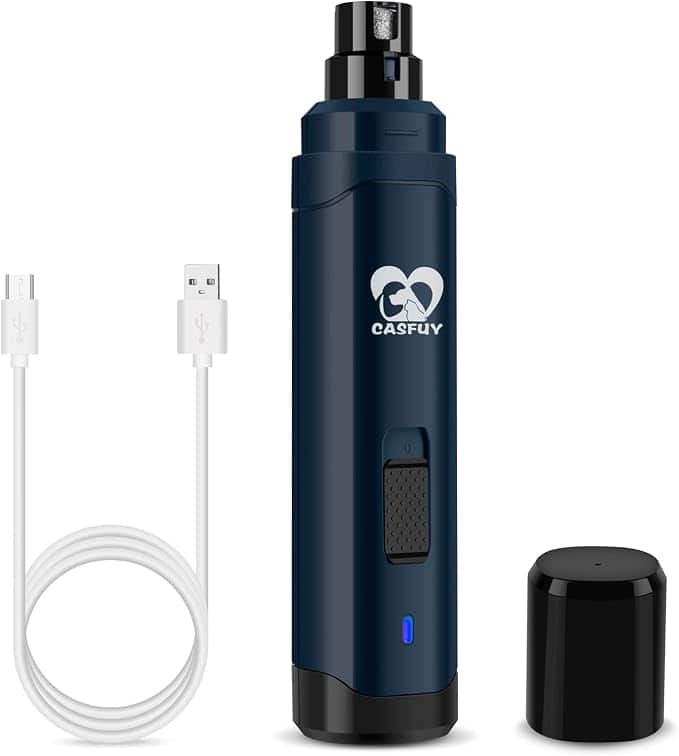
The Casfuy is the grinder I’d hand to almost anyone starting out, and it’s become the default for a reason: it gets the fundamentals right. It’s quiet and low on vibration — the two things that spook dogs most — so there’s far less of the flinching you get with a noisy, buzzy tool. That alone makes the whole job easier, because a calm dog is a still dog.
It’s rechargeable via USB with a decent runtime, so you’re not tethered to a socket or forever swapping batteries, and it has two speeds plus a protective cap with different-sized openings for small, medium and large nails. The port design is genuinely useful — it guards the spinning wheel so you can only touch the nail to it in a controlled way, which is reassuring when you’re new to grinding.
It’s earned a staggering following among UK owners, and in this case the crowd is right — it’s a well-judged, no-drama tool at a fair price. Unless your dog has particularly thick nails (in which case see the 6-speed below), this is the one I’d buy first.
- Quiet and low-vibration — kinder to nervous dogs
- USB rechargeable with a good runtime
- Two speeds and sized ports for different nails
- The owner favourite, and deservedly so
- Very thick large-breed nails are better suited to the 6-speed
2. LED-Light 3-Speed Grinder
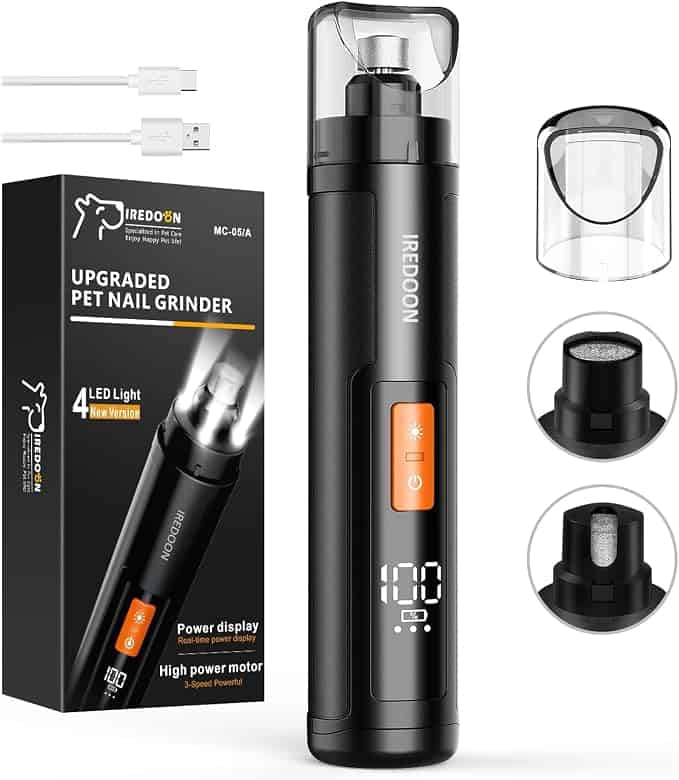
The scariest part of trimming nails is not being able to see the quick — the sensitive vein inside the nail you mustn’t hit, which is invisible on dark nails. This grinder tackles that head-on with four built-in LED lights that shine through the nail as you work, so on pale nails you can actually see the quick and stop in good time. If nervousness about cutting too far is what’s held you back, this is the clever fix.
Beyond the lights it’s a strong all-rounder: three speeds to suit different nail types, super-quiet running, and the usual sized ports. It’s the highest-rated grinder in this guide, and the extra visibility genuinely builds your confidence, which makes you calmer — and your dog calmer with you.
It’s a touch pricier than the Casfuy, and to be fair the lights help most on light-coloured nails; on very dark nails the quick is hard to see whatever you do. But for most dogs it’s a real, practical advantage, and my pick if you’re anxious about the quick.
- Four LED lights help you see and avoid the quick
- Three speeds; super-quiet running
- Highest-rated grinder here
- Builds confidence for nervous trimmers
- Lights help most on pale nails; dark nails still hide the quick
3. Casfuy 6-Speed Grinder
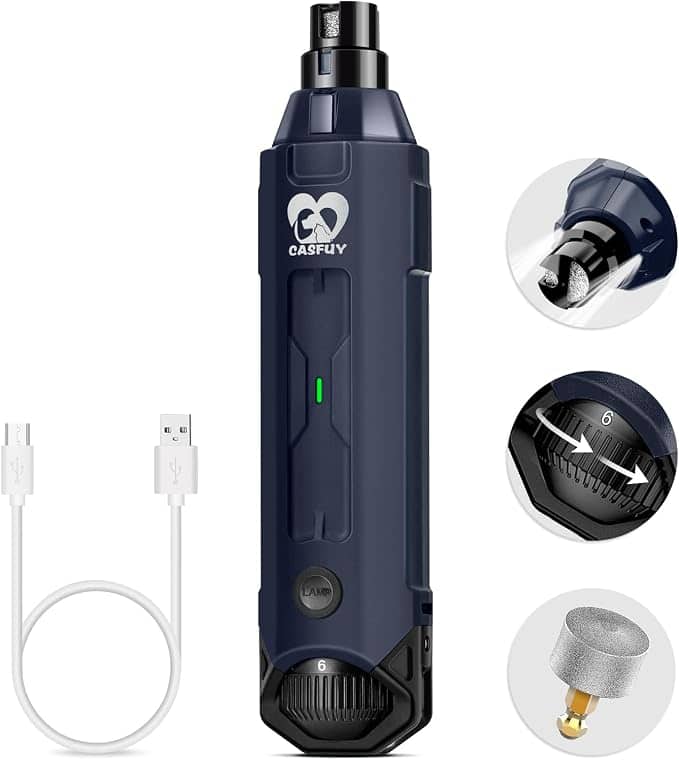
Big dogs have big, tough nails, and a gentle grinder can feel like it’s barely making a dent. This 6-speed Casfuy is the answer — more power and a wider range of speeds, so you can wind it up for thick Labrador or German Shepherd nails and dial it back down for a cat or a small dog. It’s the same quiet, low-vibration Casfuy design, just with more grunt when you need it.
The extra speeds are genuinely useful: a fast setting gets through a thick nail without you having to press (pressing is what generates heat and worries dogs), while a slow setting is perfect for careful finishing or a nervous pet. It handles a whole multi-dog, multi-size household from one tool.
All that power means it’s a little larger, and total beginners might find six speeds slightly more to think about than two. But if you’ve got a big dog, or nails the standard grinder struggles with, this is the one I’d point you to.
- More power for thick, tough large-breed nails
- Six speeds — from a cat to a big dog
- Same quiet, low-vibration Casfuy design
- Handles a whole mixed household
- A little bigger, and more settings than a beginner strictly needs
4. 2-Speed Touch-Switch Grinder
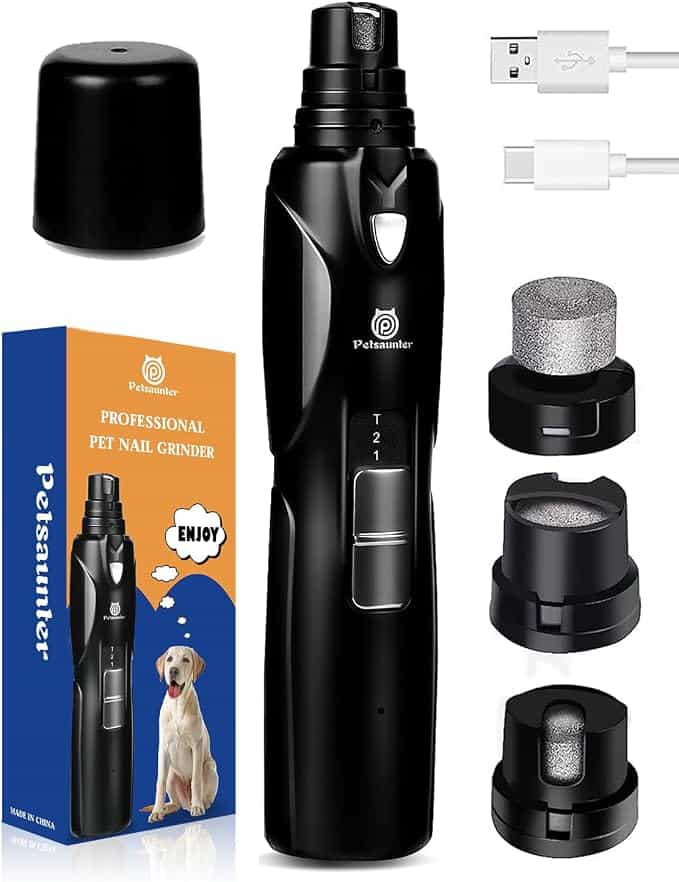
If you just want to try grinding without spending much, this budget option covers the essentials and then some. It’s the cheapest here by a clear margin, yet it’s quiet, low-vibration and USB-C rechargeable, with a handy LED light, a touch switch and three sized ports for small, medium and large or thick nails. For a first grinder, it’s a very low-risk way in.
I like that it doesn’t feel stripped-back despite the price — the three ports mean it grows with you if you get a bigger dog, and the low noise is exactly what you want for a first-timer. Plenty of owners find it’s all the grinder they ever need.
It won’t have the long-term durability or the runtime of the pricier models, and the budget build is a touch less refined in the hand. But as a cheap, capable way to see whether grinding suits you and your dog, it’s hard to argue with.
- Cheapest here — low-risk first grinder
- Quiet, low-vibration, USB-C rechargeable
- LED light and three sized ports
- More features than the price suggests
- Less refined build and runtime than the pricier models
5. PETPROVED Silent Grinder
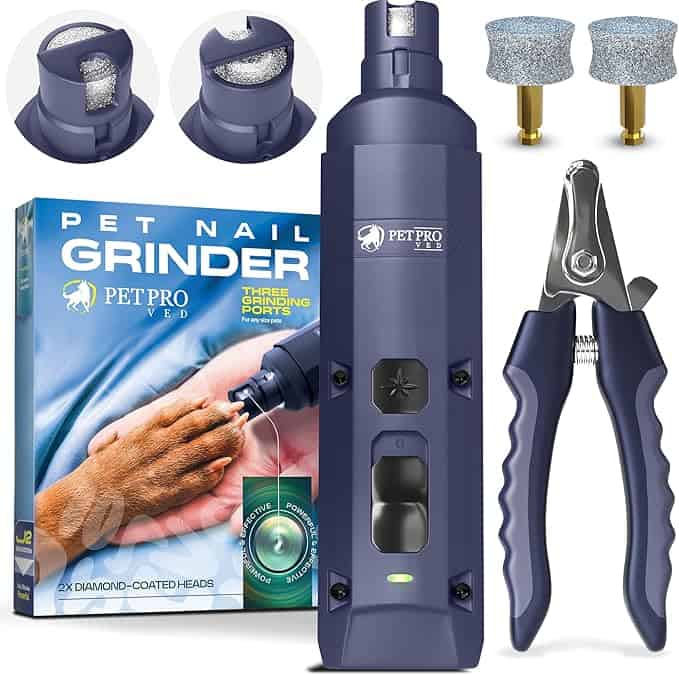
For the most sound-sensitive dogs, noise is the dealbreaker — and this PETPROVED grinder leans hard into being genuinely quiet. If your dog bolts at the first buzz, the near-silent running here can be the difference between a calm trim and a wrestling match. It’s cordless and USB rechargeable, with two speeds, an LED light and three size ports, so it’s a well-rounded tool as well as a quiet one.
I’d reach for this for anxious or noise-phobic dogs, or simply if you want the least intrusive option for gradual training sessions. Being cordless, it’s easy to handle and take room to room, and the LED light adds a bit of visibility as you work.
It’s priced around the mid-point here, so you’re paying a little for the quietness, and “silent” is relative — no motorised grinder is truly silent. But it’s among the calmest-running I’d recommend, and my pick for a genuinely sound-sensitive dog.
- Among the quietest — great for noise-phobic dogs
- Cordless and USB rechargeable
- Two speeds, LED light and three ports
- Easy to handle for gradual training
- Costs a little more, and no grinder is truly silent
How to Choose a Dog Nail Grinder
Quiet and low-vibration matters most
If I could only tell you one thing, it’s this: buy the quietest, least buzzy grinder you can. Noise and vibration are what frighten dogs off the whole process, and a calm dog makes the job quick and safe. Every grinder here is chosen with that in mind, but it’s the single spec I’d prioritise, especially for a first-timer or a sensitive dog.
Power and speeds for your dog’s size
Match the tool to the nails. A small or medium dog is fine with a standard two-speed grinder; a large breed with thick, hard nails benefits from more power and higher speeds, like the 6-speed Casfuy. The sized ports on most grinders help too — the openings guide different nail sizes onto the wheel at the right angle, which keeps things controlled.
Battery, ports and an LED light
Look for USB rechargeable with a runtime long enough to do all four paws (and ideally more than one dog) on a charge. Interchangeable or sized ports are worth having as your needs change, and a built-in LED light is a genuine bonus on pale nails, helping you see the quick. These are the details that make a grinder pleasant to live with rather than a chore.
Go slow, and mind the quick
The golden rule with grinding is little and often. Take only the very tip off, grind for a second or two at a time, and pause to check how close you are to the quick — the pinkish area on pale nails, harder to judge on dark ones. Stopping short and trimming more frequently is far better than trying to take a lot in one go. If you do nick the quick, styptic powder stops the bleeding; and if your dog is truly petrified of nail care, a groomer or vet nurse can help while you build up the training.
Frequently Asked Questions
Are nail grinders better than clippers for dogs?
For many owners, yes. A grinder files the nail down gradually rather than cutting, so there’s less risk of a painful over-cut, it leaves a smooth edge (no snagging on carpets), and it’s often easier on a dog who hates the clippers. The trade-offs are that it takes a little longer and makes a noise and vibration some dogs need to get used to. Plenty of people use clippers for the bulk and a grinder to smooth off.
Are dog nail grinders safe?
Yes, used sensibly. Because you remove a little at a time, a grinder is more forgiving than clippers — but you can still grind too far, so stop before the quick and don’t hold the tool on one spot long enough to build up heat. Keep long fur clear of the spinning wheel (tuck it back or use the port), and grind in short bursts. Take it slowly and it’s a very safe way to manage nails.
How do I get my dog used to a nail grinder?
Introduce it gradually. Let your dog sniff it switched off, then turn it on nearby (without touching them) and reward calm behaviour with treats. Over several short sessions, work up to touching it briefly to one nail, then a little grinding, always keeping it positive and stopping before they get anxious. A quiet, low-vibration grinder makes this far easier. Patience early on pays off for years.
How often should I grind my dog’s nails?
Most dogs need their nails done every three to four weeks, but it varies with how much they walk on hard surfaces, which naturally wears nails down. A good test: if you can hear nails clicking on the floor, or they’re touching the ground when your dog stands, they’re too long. Grinding little and often keeps them at a healthy length and gently pushes the quick back over time.
Can I use a dog nail grinder on a puppy?
Yes, and starting young is a great idea — a puppy who learns that nail care is calm and rewarding becomes a dog who’s easy to trim for life. Use a quiet grinder, go extra gently, do just a nail or two at a time, and pile on the praise and treats. Their tiny nails need very little taken off, so keep sessions short and positive.
Our Verdict
For most dogs, the Casfuy Upgraded is the best dog nail grinder in the UK — quiet, low-vibration, rechargeable and beginner-friendly, and the one I’d buy first. If you’re anxious about the quick, the LED-light grinder helps you see it, big dogs want the powerful 6-speed Casfuy, the budget 2-speed is a great cheap starting point, and the PETPROVED silent grinder suits the most noise-sensitive dogs.
Prefer to snip rather than grind? Our guide to the best dog nail clippers covers that side, and many owners use both. Grinding is just one part of keeping your dog well-groomed at home — pair it with the best dog grooming brushes and, for coats, the best dog clippers. And if you groom regularly, a proper grooming table saves your back and keeps your dog steady.