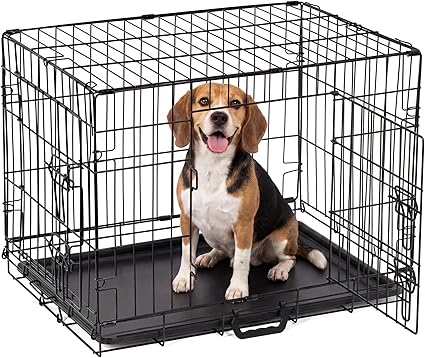
A crate isn’t a cage — used properly, it’s a safe den your dog chooses for rest, recovery and a bit of peace and quiet. The best dog crate for most UK homes is the MidWest 30-Inch Two-Door iCrate — a folding metal crate with a divider, two doors and well over 67,000 reviews behind it.
Below are five crates covering every job a crate does: a folding metal all-rounder, a heavy-duty option for strong dogs and chewers, a soft fabric crate for travel and holidays, a handsome furniture-style crate for the living room, and a genuine budget pick. There’s also a plain-English guide to sizing a crate correctly and crate-training kindly — because a crate only works if your dog is happy to be in it.
Key Takeaways
- Best overall: the MidWest 30-Inch Two-Door iCrate — a folding metal crate with a divider and two doors, backed by 67,000+ reviews.
- Best for strong dogs and chewers: the FurDreams 36-Inch Heavy-Duty Crate — a tougher wire crate with reinforced construction and secure latches.
- Best for travel: the Amazon Basics 4-Door Soft-Sided Travel Crate — a lightweight fabric crate that folds flat for the car, caravan or a friend’s spare room.
- Best furniture-style crate: the Yaheetech Dog Crate End Table — the highest-rated crate in this guide, doubling as a wooden side table.
- Best budget buy: the Folding Metal Dog Crate (30-Inch, 2-Door) — a well-rated folding crate at the keenest price here.
- A crate should never be used as punishment, and no dog should be shut in one for long stretches — the RSPCA and Blue Cross are clear that a crate is a short-term den, not all-day confinement.
- Size it so your dog can stand up, turn around and lie flat on their side. For a growing puppy, buy for the adult size and use a divider to shrink the space.
The 5 Best Dog Crates UK
1. MidWest 30-Inch Two-Door iCrate
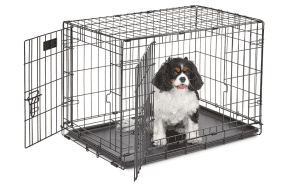
With more than 67,000 reviews at 4.6 stars, the MidWest iCrate is the folding metal crate almost every trainer and breeder ends up recommending — and for good reason. It arrives flat, folds up in under a minute with no tools, and sets up just as quickly, so it moves between rooms, cars and holidays without a fuss. The 30-inch size suits medium breeds such as Spaniels, Beagles and smaller Bulldogs, and MidWest makes the same crate in a full ladder of sizes if your dog is bigger or smaller.
Two things lift it above the crowd. The first is the included divider panel: with a puppy you set the crate to the adult size and move the divider along as they grow, so you buy once rather than three times. The second is the two-door layout — a front and a side door — which makes the crate far easier to place in a corner or beside a sofa, and gives an anxious dog a clear line of sight out.
A plastic leak-proof tray slides out for cleaning, the rounded corners spare your skirting boards, and the whole thing is reassuringly sturdy without being heavy. It isn’t built for a determined escape artist or a serious chewer — that’s the next crate’s job — but for the ordinary business of house-training, settling a puppy and giving an adult dog a den of their own, it’s as good as folding crates get.
- 67,000+ reviews at 4.6 stars — a huge track record
- Divider panel grows with a puppy, so you buy once
- Two doors for flexible placement in any room
- Folds flat in seconds with no tools; slide-out tray
- Standard wire build — a committed chewer or escape artist needs the heavy-duty pick below
2. FurDreams 36-Inch Heavy-Duty Dog Crate
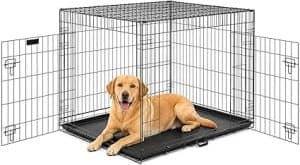
Some dogs treat a standard wire crate as a puzzle to be solved. If yours bends bars, pops catches or chews their way loose, you need a step up — and the FurDreams heavy-duty crate is that step. Rated 4.5 stars from over 3,300 reviews, it’s built from thicker gauge metal than an everyday folding crate, with reinforced corners and a chew-resistant finish designed to shrug off teeth and claws that would mark a lighter cage.
The security is in the details. Slide-bolt latches on both the front and side doors are much harder for a clever dog to nose open than the simple spring catches on budget crates, and the heavier frame resists the rocking and shoving that lets a strong dog work a flimsy crate across the floor. At 36 inches it takes a larger dog comfortably, and it still folds down for storage and transport when you need it out of the way.
Two honest notes. A crate like this is heavier to carry, and no wire crate on earth is truly indestructible — a dog panicking from genuine distress can still injure themselves trying to escape any crate. If your dog is frantic rather than simply bored, that points to separation anxiety, which needs training and often professional help rather than a stronger cage. For a boisterous, chewy but otherwise settled dog, though, this is the crate that finally holds.
- Thicker metal and reinforced corners for strong dogs
- Secure slide-bolt latches on two doors resist nosing open
- Chew-resistant finish stands up to teeth and claws
- 4.5 stars from 3,300+ reviews; still folds for storage
- Heavier to move than a lightweight folding crate
3. Amazon Basics 4-Door Soft-Sided Travel Crate
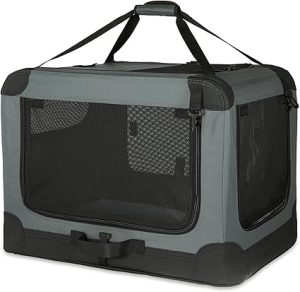
A metal crate is the right tool at home, but it’s a heavy, awkward thing to lug to a caravan, a campsite or a friend’s spare room. For those jobs a soft crate wins, and this Amazon Basics fabric crate is the sensible-value pick — 4.5 stars from more than 14,000 reviews. It’s a lightweight frame wrapped in mesh and tough fabric, with four zip-down doors so you can get your dog in and out whichever way the space allows.
The appeal is portability. It collapses flat like a pop-up tent, weighs very little, and slips behind a car seat or into a cupboard until the next trip. The mesh panels give plenty of airflow and a settled dog a full view out, which many dogs find far less stressful than a solid box. It’s an ideal second crate for holidays, days out and staying with family, and a calm, crate-trained adult will happily use it as a familiar den away from home.
Match it to the right dog, though. Soft crates are for dogs who already understand and respect a crate — the fabric is no match for a determined chewer or a puppy in a digging phase, and it isn’t a car safety restraint. For a crash-protected car option you want a rigid, tested travel crate. But as a light, foldable den for the settled dog on the move, it’s hard to beat for the money.
- Very light and folds flat — ideal for car, caravan and holidays
- Four zip doors for easy access in any layout
- Breathable mesh with a full view out to reduce stress
- 4.5 stars from 14,000+ reviews at a friendly price
- Fabric won’t survive a serious chewer, and it’s not a crash-tested car restraint
4. Yaheetech Dog Crate Furniture End Table
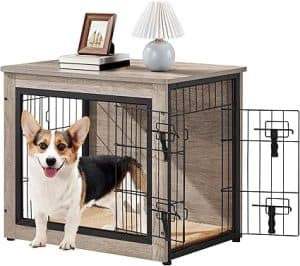
The old objection to crates was always that they look like something from a kennel block in the middle of your living room. This Yaheetech crate answers that neatly: it’s a proper wooden end table with a slatted cabinet underneath that happens to be a dog crate. At 4.7 stars it’s the highest-rated crate in this guide, and it lets you keep a den in the lounge without the room looking like a vet’s waiting area.
The wooden top is flat and sturdy enough for a lamp, a plant or your morning coffee, so the crate earns its floor space as furniture rather than just occupying it. Double doors make it easy to place and easy for your dog to come and go, the slatted sides give good airflow and sightlines, and the finish suits a modern or country-style room far better than bare wire. A soft mat inside turns it into a genuinely inviting spot your dog will choose to nap in.
It’s a premium buy rather than a bargain, and wooden furniture crates suit dogs who are already relaxed about crating — a puppy still in the mouthing-everything stage may nibble the frame, so it’s better introduced once crate manners are established. For a calm adult dog and an owner who cares how the room looks, it’s a lovely thing to own.
- Highest rating in this guide — 4.7 stars
- Doubles as a real wooden end table with a usable top
- Double doors and slatted sides for airflow and easy access
- Looks like furniture, not a cage, in a living room
- Premium price, and the wood suits settled dogs rather than heavy chewers
5. Folding Metal Dog Crate (30-Inch, 2-Door)
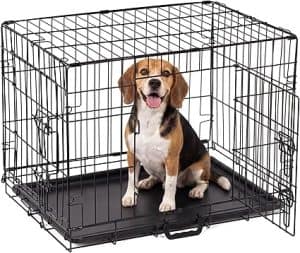
If you want the essentials of a good folding crate without paying a premium, this is the pick. Rated 4.6 stars, it’s the keenest-priced crate in the guide and covers the fundamentals properly: a fold-flat metal frame, two doors for flexible placement, secure latches and a removable tray that pulls out for cleaning. For house-training a puppy or giving a medium dog a den, it does the core job the winner does for noticeably less.
Crates are one of those puppy costs that quietly add up alongside the bed, the pen and the vet bills — our guide to the cost of owning a dog lays out the wider picture — so a crate that does 90% of the job for a fraction of the price is worth knowing about. Assembly is tool-free, it folds flat to store or move, and the two-door design means it isn’t fussy about where in the room it lives.
You give up a little of the polish and the enormous review history of the MidWest — the tray and catches feel slightly more basic — but nothing that matters for everyday use. For a first crate, a spare crate, or simply keeping the cost down, it’s the value champion here.
- Lowest price in this guide with a 4.6-star rating
- Two doors and a fold-flat frame, tool-free to set up
- Removable tray slides out for quick cleaning
- A sensible first crate or spare crate
- Tray and catches feel more basic than the pricier MidWest; no divider included
How to Choose a Dog Crate
Get the size right first
Size is the one thing you cannot compromise on. Your dog should be able to stand up fully without ducking, turn around comfortably, and lie flat on their side with legs stretched out. Too small is unkind; surprisingly, too big can slow house-training, because a dog will happily toilet in one end of a cavernous crate and sleep in the other. For a puppy, the trick recommended by trainers and by Dogs Trust is to buy for the adult size and use a divider panel to shrink the usable space, moving it along as your puppy grows.
Match the crate type to the dog and the job
A folding metal crate is the default for home use — sturdy, airy and easy to clean. A heavy-duty crate with a reinforced frame and slide-bolt latches is for strong dogs and chewers who defeat ordinary cages. A soft fabric crate is light and packable for travel and holidays, but only for dogs who already respect a crate and won’t chew it. Furniture-style wooden crates blend into a living room and suit calm, settled dogs. And for the car, neither soft nor light wire crates are a safety device — a rigid, purpose-built and ideally crash-tested car crate is a separate purchase. Many owners end up with two: a solid crate at home and a lighter one for trips.
Crate-train kindly, and never as a punishment
A crate is only a good thing if your dog is happy to be in it. The RSPCA, Blue Cross and Dogs Trust all frame the crate the same way — as a safe den the dog chooses, introduced slowly with treats, meals and comfy bedding so it becomes their favourite spot rather than somewhere they’re shut away. Feed your dog in it, leave the door open at first, and build up time in tiny steps. Never use the crate as a telling-off or a place to banish your dog when they’ve misbehaved, because that poisons the one association you’re trying to build. If shutting your dog in causes real panic, drooling or frantic escape attempts, stop and read up on separation anxiety rather than pushing on.
Don’t over-use it
A crate is for short-term rest, house-training and safe management — not all-day containment. Welfare charities advise that an adult dog shouldn’t be crated for long, unbroken stretches, and puppies need very frequent breaks to toilet, stretch and play. As a rough steer, the crate is for sleeping, settling and the odd hour of calm, not a substitute for company, exercise and a proper routine. If you need to manage where your dog goes for longer periods, a dog gate or a puppy pen gives them room to move while still keeping them safe.
Frequently Asked Questions
Are dog crates cruel?
Not when they’re used properly. UK welfare charities including the RSPCA and Blue Cross support crates as a safe den, provided the dog is trained to enjoy it, the crate is the right size, and the dog isn’t shut in for long periods or as a punishment. A crate becomes unkind only when it’s misused — too small, used for hours on end, or as a place of banishment. Introduced kindly, most dogs come to treat their crate as the comfiest, safest spot in the house.
What size crate does my dog need?
Measure your dog from nose to base of tail and add roughly 10–15cm for length, then measure their height sitting and standing and allow headroom on top. They must be able to stand, turn around and lie flat. If you’re between sizes, go up. For a growing puppy, buy for the expected adult size and use a divider to keep the space right at each stage.
How long can a dog be left in a crate?
As little as possible, and never as a way to avoid giving your dog company and exercise. Puppies need a break every couple of hours at most to toilet and stretch, and even a house-trained adult shouldn’t be crated for long, unbroken stretches during the day. The crate is for sleeping and short periods of calm, not routine all-day confinement — for that you need a different plan.
How do I get my dog to like their crate?
Go slowly and make it rewarding. Leave the door open at first, feed meals inside, scatter treats in, and add soft, comfortable bedding so it feels like a den. Never force your dog in or shut the door before they’re relaxed being inside. Build up the time in small steps, and keep the crate a positive place — somewhere good things happen, never somewhere they’re sent as a punishment.
Should I put a bed or blanket in the crate?
Yes — comfortable bedding makes the crate far more inviting, and most dogs settle better with something soft to curl up on. For a puppy or a chewer, choose something they can’t shred and swallow; a tough, washable mat is safer than a plump duvet, and a genuinely chew-proof dog bed is worth the outlay if your dog destroys ordinary bedding. Keep it clean and washable, since crates see the odd accident during house-training.
Our Verdict
For most UK homes, the MidWest 30-Inch Two-Door iCrate is the best dog crate you can buy — the divider grows with a puppy, the two doors make it easy to place, and 67,000 reviews are hard to argue with. Strong dogs and chewers should step up to the FurDreams heavy-duty crate, while travellers want the packable Amazon Basics soft crate. If you’d rather not look at wire in the lounge, the Yaheetech furniture crate is a beautiful compromise, and the budget folding crate covers the basics for less.
Whichever you choose, remember that the crate itself is only half the story — the training is the rest. Introduce it slowly and kindly, keep sessions short, and never use it as a punishment. Take heart, too: the crate-and-chaos stage of puppyhood really does pass, usually around the time puppies calm down and start choosing their den for a quiet snooze all by themselves.