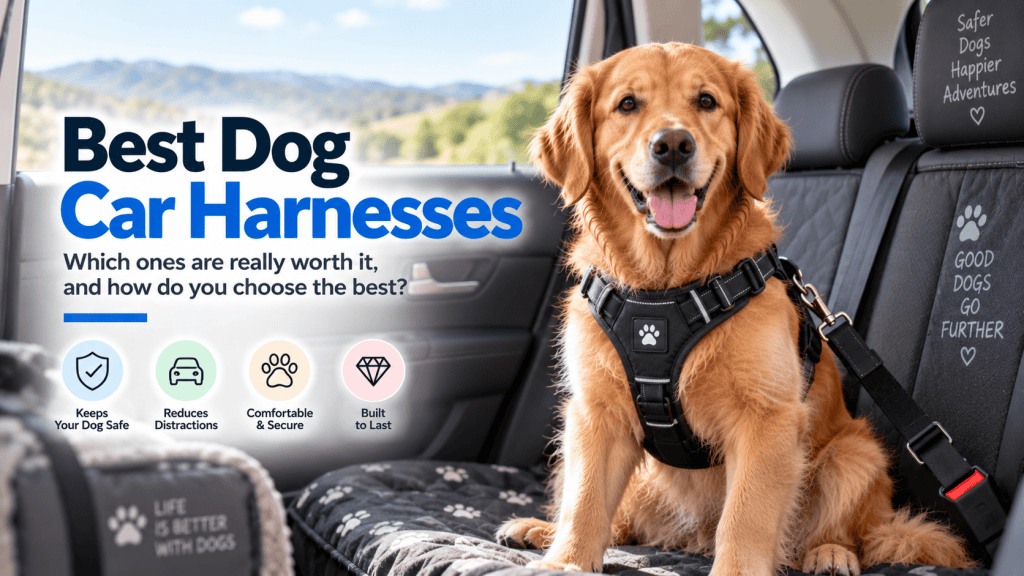
An unrestrained dog in the car is a risk to everyone in it — a distraction on the move, and in a crash or hard stop, a heavy projectile. The Highway Code says dogs must be suitably restrained, and the safest way to do that on the back seat is a proper car harness clipped to the seatbelt. It protects your dog, protects you, and keeps you on the right side of the rules.
The best dog car harness in the UK is the Kurgo Enhanced Strength Tru-Fit. It’s genuinely crash-tested, with steel nesting buckles and five adjustment points for a secure fit, and it comes with a seatbelt tether in the box — the one I’d trust to actually hold a dog in an accident.
Below are the five I’d recommend, from that crash-tested harness to the simple seatbelt tethers that clip an existing harness to the buckle, plus how to fit them safely — and the one mistake that makes any of them dangerous.
Key Takeaways
- Best overall: the Kurgo Tru-Fit Crash-Tested Harness — a proper crash-tested harness with steel buckles and an included tether.
- Best seat belt tethers: the 2-Pack Adjustable Seat Belts — heavy-duty elastic tethers to clip your dog’s harness to the buckle.
- Best budget: the Adjustable Dog Car Safety Belt — a simple, well-made tether for a few pounds.
- Best for chewers: the Chew-Proof Steel Cable Belt — a steel-cored tether for dogs that gnaw through fabric.
- Best for two dogs: the SlowTon Double Bungee Belt — a shock-absorbing tether that splits for two dogs.
- Always clip a tether to a well-fitted harness — never to your dog’s collar, which can cause serious neck injury.
- A crash-tested harness is the safest option; tethers restrain and stop distraction but aren’t all crash-rated.
The 5 Best Dog Car Harnesses UK
1. Kurgo Enhanced Strength Tru-Fit Crash-Tested Harness
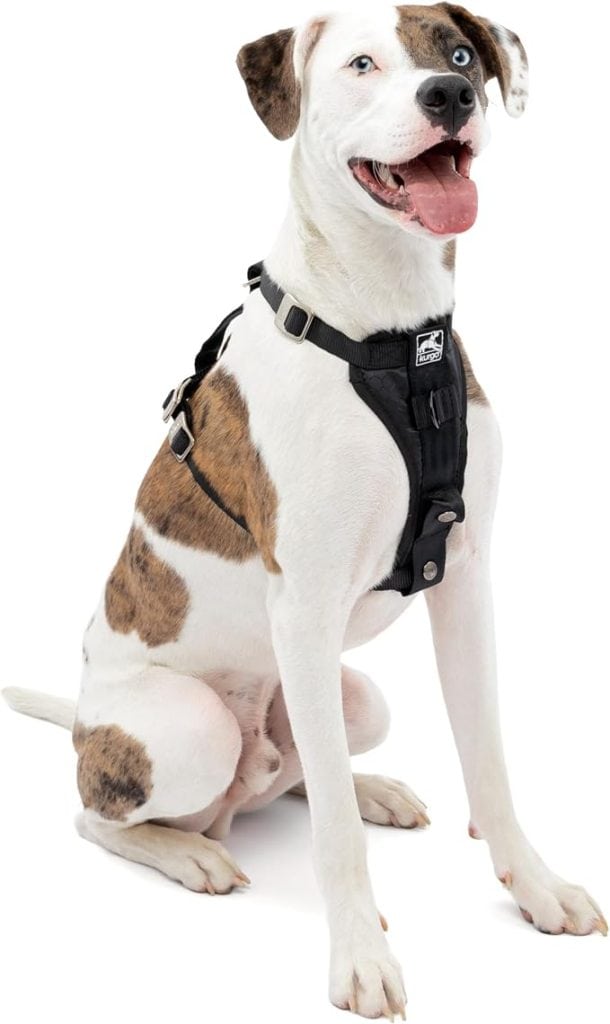
If you take car safety seriously — and with a dog on board, I think you should — this is the harness to buy. Unlike most “car harnesses”, which are really just tethers, the Kurgo Tru-Fit is an actual crash-tested harness: a padded vest with five adjustment points and, crucially, steel nesting buckles rather than plastic ones, which is exactly what you want holding your dog if you ever stop hard.
It comes with a seatbelt tether in the box, so it’s a complete solution out of the packet — put the harness on your dog, clip the short tether to the seatbelt, and they’re properly secured on the back seat. The five-point fit means you can get it snug on almost any body shape, and because it doubles as a walking harness, you’re not carrying separate kit for the car and the park.
It costs more than a simple tether, and being a full harness it takes a moment longer to put on. But it’s the only type here I’d genuinely trust in a real accident, and that peace of mind is the whole point. For most dogs and most owners, this is the one worth paying for.
- Genuinely crash-tested — the safest option here
- Steel nesting buckles, not plastic
- Five-point adjustable fit; includes a seatbelt tether
- Doubles as a walking harness
- Dearer than a plain tether, and takes a moment longer to fit
2. 2-Pack Adjustable Seat Belts
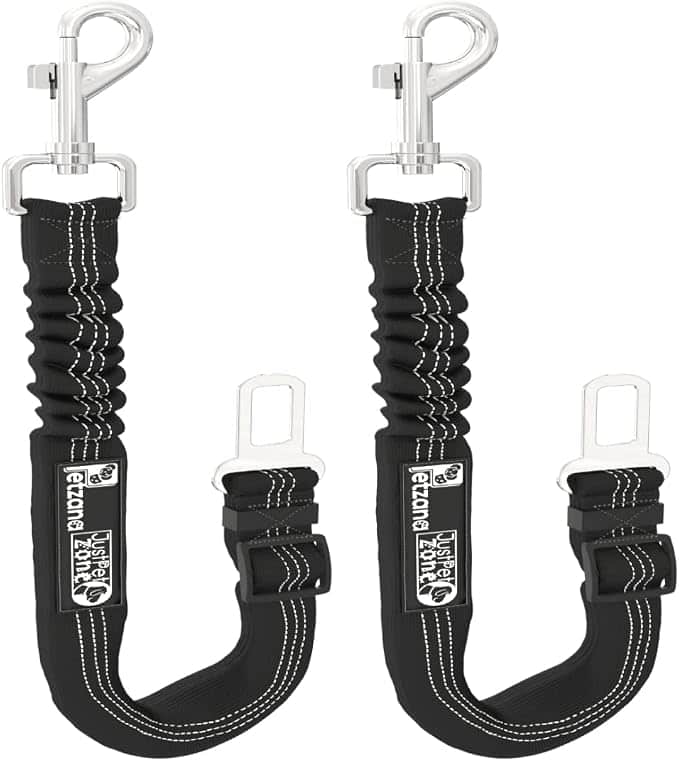
If you already have a sturdy harness you’re happy with, you don’t necessarily need a whole new one — you need the tether that connects it to the car. This is the one I’d get: a two-pack of heavy-duty, double-layer elastic seatbelts that clip your dog’s harness to the seatbelt buckle or slot into the belt receiver. It’s comfortably the most popular restraint of its kind in the UK, and for good reason.
The elastic gives a little to absorb a sudden jolt rather than jarring your dog, and the length adjusts so they can sit, stand and lie down without roaming the whole cabin. Getting two in the pack is genuinely useful — one for each car, or a spare that lives in the glovebox — and at this price it’s an easy add-on.
The important caveat, which applies to every tether here, is that it’s only as safe as what you clip it to: always attach it to a proper harness, never your dog’s collar. Do that, and it’s a simple, effective way to stop your dog wandering and distracting you on the move.
- Two tethers in the pack — one per car or a spare
- Heavy-duty double-layer elastic absorbs jolts
- Adjustable length; clips to buckle or belt receiver
- The UK’s go-to seat belt tether
- A tether only — you must supply a proper harness to clip it to
3. Adjustable Dog Car Safety Belt
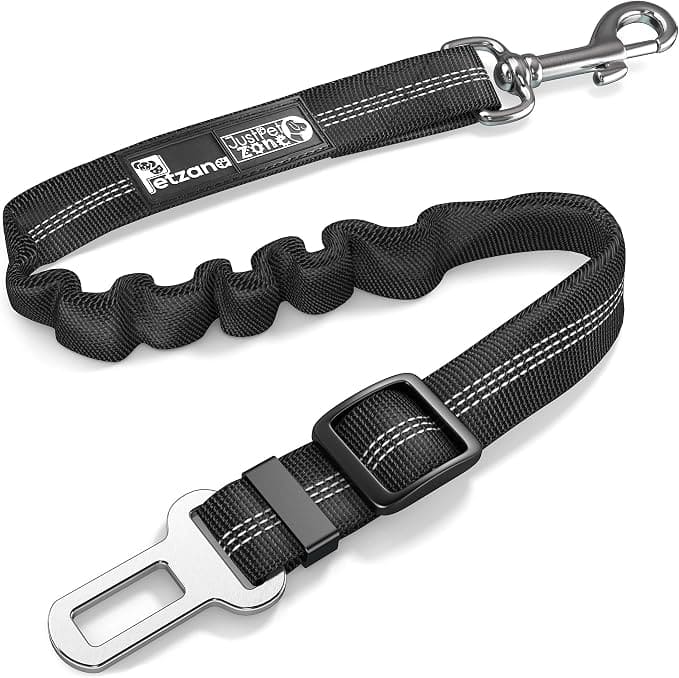
For the smallest possible outlay, this single adjustable safety belt does the core job well. It’s a simple tether that plugs into the seatbelt receiver at one end and clips to your dog’s harness at the other, with an adjustable length so they can settle comfortably. If you just want to stop your dog clambering into the front while you drive, it’s all you strictly need.
Despite the low price it’s well-made and popular, and I’d happily keep one in a second car or lend it to whoever’s dog-sitting. It’s the sort of cheap, sensible bit of kit that there’s really no excuse not to have if your dog travels with you.
It’s a basic tether, so there’s no crash-test rating and no bungee section to soften a jolt — you’re getting restraint and anti-distraction rather than crash protection. Clip it to a good harness and it’s a fine budget choice; for maximum safety, step up to the Kurgo.
- Cheapest option — no excuse not to have one
- Adjustable length; plugs into the seatbelt receiver
- Simple and well-made
- Great spare for a second car
- Basic tether — no crash rating or shock-absorbing section
4. Chew-Proof Steel Cable Belt
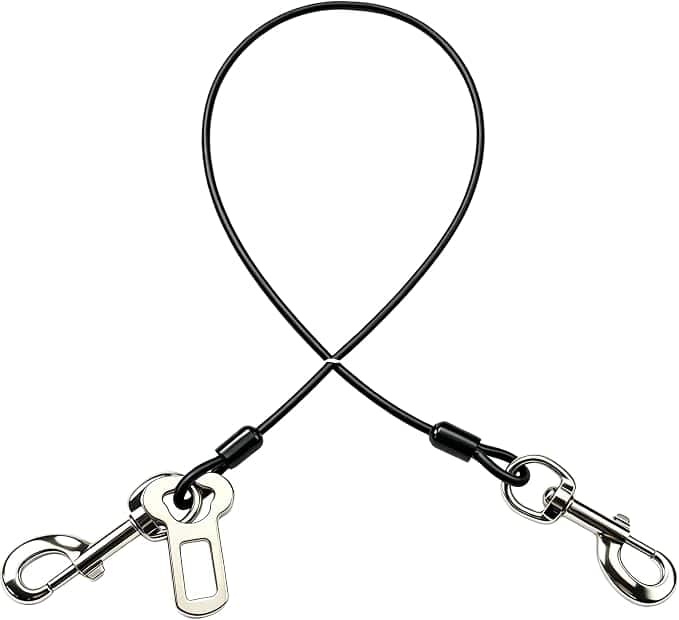
Some dogs treat a fabric tether as a chew toy, and a gnawed-through strap is no restraint at all. If that’s your dog, this is the answer: a tether built around a steel rope cable, so even a determined chewer can’t bite through it. It has double clips and a latch attachment, and a waterproof coating that wipes clean after muddy trips.
I’d reach for this for anxious or bored travellers who chew when they’re unsettled, and for young dogs still in their destructive phase. The steel core takes the worry out of leaving them clipped in, and it still adjusts and clips to a harness like any other tether.
It’s firmer than an elastic belt, so there’s less give to cushion a sudden stop, and the cable is a little less flexible to handle. But for a chewer, a tether that survives is far safer than a comfier one they can destroy — and it’s cheap enough to be a no-brainer for the right dog.
- Steel cable core survives determined chewers
- Double clips and latch attachment
- Waterproof and wipe-clean
- Cheap peace of mind for a chewer
- Less give than an elastic belt; cable is stiffer to handle
5. SlowTon Double Bungee Belt
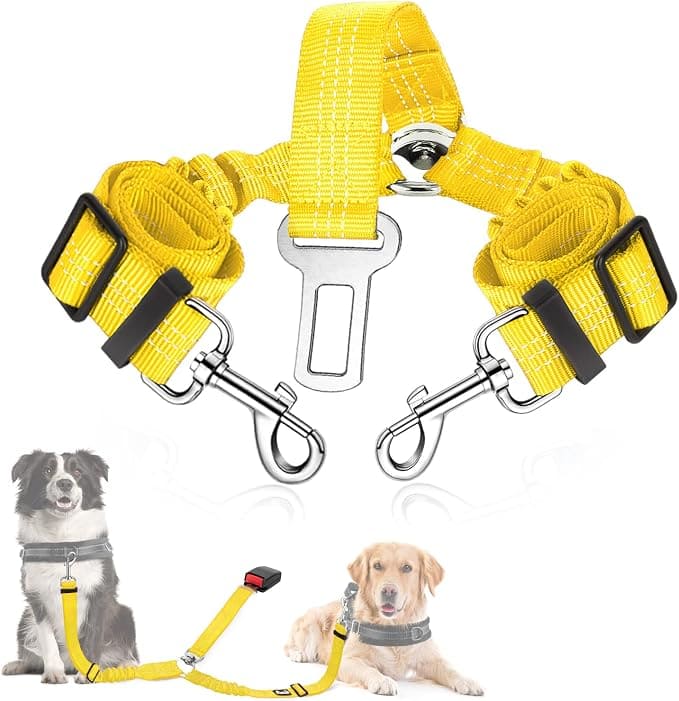
Travelling with two dogs on one seatbelt is a common headache, and this SlowTon belt is built for it — a single anchor that splits into two adjustable tethers, so you can secure a pair of dogs side by side without them tangling into one another. It’s reflective and heavy-duty, and I like the anti-shock bungee section that softens a sudden stop rather than snapping tight.
That bungee buffer is the standout feature even if you’ve only got one dog: it takes the jolt out of an emergency brake, which is kinder on your dog and on the fixings. Clip each end to a harness and you’ve got a tidy, comfortable restraint for a multi-dog back seat.
With two dogs on one anchor point there’s naturally less independent movement, and like all tethers it needs proper harnesses on both dogs to be safe. But for two-dog households it solves a real problem neatly, and the shock-absorbing design is a genuinely nice touch.
- Splits into two tethers for a pair of dogs
- Anti-shock bungee softens hard stops
- Reflective, heavy-duty and adjustable
- Tidy solution for a multi-dog back seat
- Two dogs share one anchor, so less independent movement
How to Choose a Dog Car Harness
Harness vs tether — know the difference
There are really two products here. A car harness is a padded vest your dog wears, and the best (like the Kurgo) are crash-tested to hold a dog in an accident. A seatbelt tether is just the strap that connects a harness to the seatbelt — it restrains your dog and stops distraction, but it relies entirely on the harness it’s clipped to. For the most protection, use a crash-tested harness; if you already own a strong harness, a good tether turns it into a car restraint.
The one rule: clip to a harness, never a collar
This is the mistake that turns a safety device into a hazard, so I’ll say it plainly: never attach a car tether to your dog’s collar. In a sudden stop, all the force goes through their neck and can cause serious injury. A tether must always clip to a well-fitted body harness that spreads the load across the chest. If you take one thing from this guide, make it that.
Fit and size
A restraint only works if it fits. For a harness, measure your dog’s chest girth and neck and use the maker’s size chart, then adjust so it’s snug but not tight — you should fit two fingers under the straps. A harness that’s too loose can let a dog slip out or twist; too tight is uncomfortable and they’ll resist wearing it. For tethers, keep the length short enough that your dog can’t reach the front seats or a window.
Comfort, chewing and the law
Match the restraint to your dog. Anxious or chewy dogs do better with a steel-cored tether; nervous travellers appreciate a padded harness and a bungee section that softens stops. And remember the legal side: Rule 57 of the Highway Code requires dogs to be suitably restrained so they can’t distract or injure you — a harness and seatbelt, a crate, or a dog guard all qualify. Getting this right keeps your dog safe and you insured.
Frequently Asked Questions
Do I legally need to restrain my dog in the car in the UK?
Yes — Rule 57 of the Highway Code states that dogs must be suitably restrained so they can’t distract or injure you, or hurt themselves, if you stop quickly. Acceptable methods are a seatbelt harness, a dog crate, a dog cage or a dog guard. While Rule 57 itself is advisory, driving with an unrestrained dog can lead to a careless-driving charge and can invalidate your insurance, so it’s well worth getting right.
Are dog car harnesses safe in a crash?
A genuinely crash-tested harness, like the Kurgo here, is designed and tested to hold a dog in an accident, and is the safest option. Many cheaper “car harnesses” and tethers restrain your dog and prevent distraction but aren’t crash-rated — they’re still far better than nothing, but for real crash protection choose a harness that states it’s crash-tested, with metal rather than plastic buckles.
Can I attach a dog seat belt to my dog’s collar?
No — never. Clipping a car tether to a collar means all the force in a sudden stop goes through your dog’s neck, risking serious injury. Always attach a tether to a properly fitted body harness, which spreads the load across the chest and shoulders. This is the single most important safety point with any dog car restraint.
What’s the best dog car harness for a chewer?
For a dog that chews through fabric, a tether with a steel cable core (like the chew-proof belt here) is the answer, because they can’t bite through it. Pair it with a tough harness and you can leave them clipped in without worrying they’ll free themselves. For the harness itself, look for sturdy webbing and metal buckles rather than plastic.
Where should my dog travel in the car?
The back seat, restrained with a harness and tether, or the boot behind a dog guard, are the safest spots — never a lap or the front seat, where an airbag can seriously hurt a dog. On the back seat, keep the tether short enough that your dog can’t reach the windows or climb through to the front. A seat cover on top keeps everything clean.
Our Verdict
For real safety, the Kurgo Tru-Fit is the best dog car harness in the UK — a proper crash-tested harness with steel buckles and a tether included, and the one I’d trust in an accident. If you already have a good harness, the 2-pack seat belts are the tethers to get, the budget belt covers the basics for pennies, the steel-cable belt beats chewers, and the SlowTon double sorts out two dogs.
A harness is one half of travelling safely; keeping the car clean is the other. Pair it with one of the best dog car seat covers to protect your seats, and for bigger dogs or boot travel our guides to dog car seats and dog travel requirements are worth a read. Just don’t confuse a car harness with a walking harness — they’re built for different jobs, and only a crash-tested one belongs in the car.