Grain-free dog food is genuinely useful for the minority of dogs with a diagnosed grain sensitivity — but for most dogs it’s a preference, not a health upgrade. If you’ve decided grain-free is right for your dog (ideally after a chat with your vet), our top pick is the Harringtons Superfoods Complete Grain Free — a complete, all-natural recipe that’s also the best value big bag in this guide.
Before we get to the picks, one honest bit of myth-busting. Grain-free has been marketed as inherently healthier, and that isn’t what the current veterinary consensus says. Most dogs digest cooked grains such as rice and oats perfectly well, and whole grains are a useful source of fibre, energy and nutrients. True grain allergies are uncommon — when dogs do react to food, it’s usually to a protein like beef, dairy or chicken rather than to grain. So grain-free earns its place for specific dogs and specific reasons, which is exactly how the five foods below are framed.
Key Takeaways
- Best overall (and best value): the Harringtons Superfoods Complete Grain Free — a complete, all-natural chicken recipe from a trusted UK brand, at the lowest price per kilo here.
- Best premium/natural: the Lily’s Kitchen Chicken & Duck Grain-Free — freshly prepared meat and natural ingredients, and the most-reviewed food in this guide.
- Best for skin & coat: the Pooch & Mutt Skin & Coat — a grain-free recipe built around salmon, biotin and omega oils for dry or itchy skin.
- Best for working & active dogs: the Skinner’s Field & Trial Grain Free — a proper high-energy formula for dogs that run for a living.
- Best limited-ingredient (fish): the Autarky Grain Free White Fish & Potato — a single novel-protein recipe with joint support, ideal for dogs that react to common meats.
- Grain-free is not automatically healthier. Choose it for a diagnosed sensitivity or on veterinary advice — and always pick a food labelled “complete”.
- The US FDA has investigated a possible link between some grain-free, legume-heavy diets and a heart condition (DCM). No causal link is proven, but it’s a good reason to discuss any diet change with your vet.
The 5 Best Grain-Free Dog Foods UK
1. Harringtons Superfoods Complete Grain Free Chicken
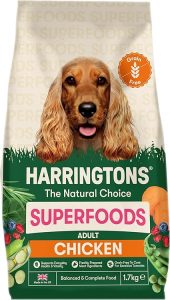
Harringtons has built its reputation on doing the simple things well at a fair price, and this Superfoods grain-free recipe is the food most UK owners should try first. It’s a complete adult diet built around chicken as the single named meat, with sweet potato, peas and a scattering of “superfood” botanicals in place of grain. There are no artificial colours, flavours or preservatives, and the ingredient list reads cleanly — which matters more than the marketing on the front of the bag.
What makes it our overall winner is the combination of a 4.7-star rating and the best value in this guide: the 12kg bag works out cheaper per kilo than anything else here, which is no small thing when a big dog empties a bag in a few weeks. For a food at this price, the quality on offer is genuinely impressive, and the hypoallergenic recipe suits dogs with mildly sensitive tummies as well as fussier eaters.
It’s a sensible default rather than a boutique product, and that’s exactly why we recommend it. If your dog has been diagnosed with a grain sensitivity, or you simply want a clean, complete grain-free food without paying a premium, this is the one to buy. As with any new food, introduce it gradually over a week (see our transition tips below).
- Best value per kilo in this guide — big-bag economy
- Complete recipe with chicken as the single named meat
- No artificial colours, flavours or preservatives
- 4.7 stars — the highest rating here
- One flavour focus — dogs that dislike chicken will want a fish recipe instead
2. Lily’s Kitchen Chicken & Duck Grain-Free
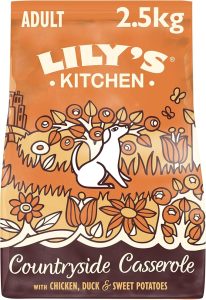
If you want a step up in quality and don’t mind paying for it, Lily’s Kitchen is the natural choice — and its enormous review count (the highest of any food here) tells you plenty of owners agree. This grain-free recipe is built around freshly prepared chicken and duck, with sweet potato and botanicals rather than grain, and the brand’s focus on natural ingredients has earned it a loyal following.
It’s a premium food in the truest sense: you’re paying more per kilo than for our winner, but you’re getting a recipe that many dogs find highly palatable and that owners of fussy eaters swear by. The bags are smaller than the working-dog sacks elsewhere in this guide, which suits small and medium households where a 12 or 15kg bag would go stale before it’s finished.
As with all grain-free foods, “premium” and “natural” don’t automatically mean “healthier” for a dog with no dietary issues — but if you’ve chosen grain-free and want the nicest version of it, this is a lovely food that dogs tend to gulp down. It also pairs well with the brand’s wet range if you like to add a topper.
- Freshly prepared chicken and duck; natural ingredients
- The most-reviewed food in this guide — proven popularity
- Highly palatable, a strong pick for fussy eaters
- Sensible bag sizes for small and medium homes
- Premium price — the dearest per kilo here for larger dogs
3. Pooch & Mutt Skin & Coat Grain Free
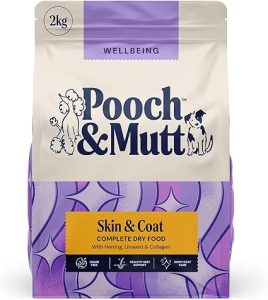
Dry, flaky or itchy skin is one of the most common reasons owners start experimenting with their dog’s diet. Pooch & Mutt’s Skin & Coat recipe is designed for exactly that: it’s grain-free and built around salmon, with added biotin, zinc and omega-3 and omega-6 oils that support the skin barrier and a glossy coat. It’s a targeted formula rather than a general food, and that focus is its strength.
A quick but important caveat, because it’s the whole point of this guide: itchy skin is far more often linked to a protein or environmental allergy — or fleas — than to grain. Going grain-free may help, but a fish-based recipe like this one can help mainly because it swaps out the common meats dogs actually react to, not simply because it removes grain. If your dog’s skin problems persist, that’s a conversation for your vet.
All that said, it’s a well-rated food that many owners credit with calmer skin and less scratching, and the regular-sized kibble suits most breeds. As a bonus, salmon-based recipes tend to go down well with dogs that have grown bored of chicken.
- Salmon-based, with biotin, zinc and omega oils for skin and coat
- Grain-free and single-focus — good for elimination trials
- Regular kibble size suits most breeds
- Well reviewed by owners of itchy-skinned dogs
- Persistent skin issues need a vet, not just a food swap
4. Skinner’s Field & Trial Grain Free Chicken & Sweet Potato
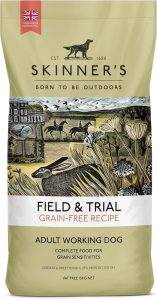
Skinner’s has been feeding British working dogs for generations, and its Field & Trial range is formulated for animals that genuinely earn their dinner — gundogs, farm dogs, sled and canicross dogs, and pets with a high-octane lifestyle. This grain-free recipe pairs chicken with sweet potato for slow-release energy, and it’s designed to keep weight and condition on dogs that burn calories all day.
It comes in a large 15kg sack, which is the sensible format for a household running one or more big, busy dogs, and it’s specifically produced for dogs with an intolerance to grains. There’s joint support built in too, which matters for animals putting their bodies through hard work over the years. It’s the most energy-dense option in this guide, and priced accordingly.
The flip side of that energy density is the one thing to watch: it’s genuinely aimed at active dogs. Feed it to a sedentary pet at working-dog quantities and you’ll simply add weight, so follow the feeding guide by activity level rather than by breed. For the right dog, though, few grain-free foods are better matched to the job.
- Purpose-built for working and high-activity dogs
- Chicken and sweet potato for slow-release energy
- Large 15kg bag suits big, busy households
- Added joint support for hard-working joints
- Energy-dense — too rich for low-activity or couch-potato dogs
5. Autarky Grain Free White Fish & Potato
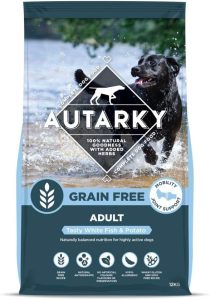
This is the pick for the dog that reacts to the usual suspects. Autarky’s White Fish & Potato is a limited-ingredient, hypoallergenic recipe: white fish as a single novel protein, potato in place of grain, and a short list of extras. Because most genuine food reactions in dogs are to common meats rather than to grain, a novel-protein food like this is often more useful for a suspected allergy than simply going grain-free with the same old chicken or beef.
It’s a big 12kg bag pitched at active dogs, with joint-care ingredients including glucosamine and green-lipped mussel, plus prebiotics for digestion and added omega oils for skin and coat. The large kibble encourages dogs to chew rather than gulp, and owners report that even fussy dogs take to the fish flavour readily.
Used properly — as part of a careful elimination approach guided by your vet — a single novel-protein food is one of the more genuinely helpful tools in the grain-free category. It’s also good value in a large bag, which makes running a trial less painful on the wallet. Just remember that an exclusion diet only works if it’s the only thing your dog eats for the trial period, treats and table scraps included.
- Single novel protein (white fish) — ideal for exclusion trials
- Hypoallergenic, grain-free and wheat-gluten free
- Joint support plus prebiotics for digestion
- Large-bag value and a flavour fussy dogs enjoy
- An exclusion trial only works if nothing else passes your dog’s lips
How to Choose a Grain-Free Dog Food
Does your dog actually need grain-free?
This is the question the packaging never asks. The honest answer, in line with current veterinary thinking, is that most dogs do not need grain-free at all. Dogs are not wolves; over thousands of years alongside us they’ve adapted to digest starch, and cooked grains such as rice and oats are broken down perfectly well by the vast majority of dogs. Whole grains also bring fibre, energy and useful nutrients to the bowl — they’re not just cheap filler.
True grain allergies are genuinely uncommon. When a dog does have a food allergy, the trigger is far more often a protein — beef, dairy or chicken are the usual culprits — than a grain. So grain-free is worth choosing for the minority of dogs with a diagnosed grain sensitivity, or on your vet’s advice. For everyone else it’s a preference, not a health upgrade, and there’s no need to feel you’re short-changing your dog by feeding a good-quality food that contains grain.
The FDA, DCM and “BEG” diets — the balanced version
You may have seen scary headlines linking grain-free food to heart disease. Here’s the measured version. The US Food and Drug Administration (FDA) opened an investigation into a possible association between some grain-free, legume-heavy diets — so-called “BEG” diets (boutique brands, exotic ingredients, grain-free) — and a heart condition in dogs called dilated cardiomyopathy, or DCM. The key word is possible: a definitive cause-and-effect link has not been established, and research is ongoing.
The takeaway isn’t panic — it’s balance. It simply means you shouldn’t assume grain-free is automatically the healthier option, and that any big change to your dog’s diet is worth discussing with your vet, especially for breeds already prone to heart problems. Choosing an established brand with a solid nutritional track record, as the foods above are, is a sensible move.
Always choose a “complete” food
Whatever you feed, make sure the label says “complete” rather than “complementary”. A complete food provides all the nutrients your dog needs in the correct balance, so it can be fed on its own. Complementary foods (many toppers and some treats) are designed to be fed alongside something else and will leave gaps if used as a main meal. Every dry food in this guide is a complete diet.
Match the life stage and activity level
Puppies, adults and seniors have different nutritional needs, and a working sheepdog burns calories a lap-dog never will. Feed a food formulated for your dog’s life stage, and follow the feeding guide by weight and activity level — the energy-dense working formula that keeps a gundog in condition will quietly pile weight onto a gentle pet. When in doubt, weigh the food rather than guessing by the scoop.
Transition gradually
Switch foods slowly over five to seven days to avoid an upset stomach: start with roughly a quarter new food to three-quarters old, then move to half and half, then three-quarters new, before going fully over at the end of the week. A sudden swap is the quickest route to loose stools, which is why a rushed change can make a perfectly good food look like it “didn’t agree” with your dog.
Frequently Asked Questions
Is grain-free dog food better for my dog?
Not inherently. For most dogs, grain-free is a preference rather than a health improvement — the current veterinary consensus is that dogs digest cooked grains such as rice and oats perfectly well. Grain-free genuinely helps the minority of dogs with a diagnosed grain sensitivity, or where a vet has recommended it. If your dog is thriving on a good food that contains grain, there’s no need to switch.
Can dogs digest grains, or are grains bad for them?
Most dogs digest grains without any trouble. Dogs have adapted to a starch-containing diet over their long history alongside people, and whole grains provide fibre, slow-release energy and useful nutrients. Grains are only a problem for the small number of dogs that are specifically sensitive to them — for the rest, they’re a perfectly healthy part of a balanced diet.
How do I know if my dog has a grain allergy?
You often can’t tell from symptoms alone, because itchy skin, ear infections and tummy upsets can be caused by protein allergies, environmental allergens or fleas just as easily as by food. True grain allergies are uncommon; protein reactions are more likely. The reliable way to identify a food trigger is a carefully controlled elimination diet run with your vet — not guesswork from the internet.
Is grain-free food linked to heart problems?
The FDA has investigated a possible association between certain grain-free, legume-heavy (“BEG”) diets and dilated cardiomyopathy (DCM) in dogs, but no definitive causal link has been proven and research continues. It’s not a reason to panic, but it is a good reason not to assume grain-free is automatically healthier. Stick to established brands and discuss any diet change with your vet, particularly for at-risk breeds.
How do I switch my dog to a new food?
Transition over five to seven days. Mix a little of the new food into the old, increasing the proportion each day until you’ve fully switched by the end of the week. This gives your dog’s digestion time to adjust and avoids the loose stools that come with a sudden change. If your dog has a very sensitive stomach, take even longer.
Our Verdict
For most owners who’ve decided on grain-free, the Harringtons Superfoods Complete Grain Free is the food to buy — complete, clean and the best value here. Want a premium natural option? The Lily’s Kitchen Chicken & Duck is the crowd favourite, while working dogs want the Skinner’s Field & Trial, itchy skin points to the Pooch & Mutt Skin & Coat, and a suspected allergy is best explored with the novel-protein Autarky White Fish & Potato.
Above all, keep the big picture in mind: grain-free is one option among many, not a guaranteed health boost. If your dog’s real issue is a delicate digestion, our guide to the best dog foods for sensitive stomachs may be more useful, and a good wet food can help fussy or older dogs eat well. Keep an eye on what comes out the other end too — our guide to how often dogs poop is a handy gauge of whether a new food suits your dog. For the wider picture on diet, weight and wellbeing see how to keep your dog healthy, and if you’re watching what goes into the bowl, it’s worth knowing whether salt is bad for dogs. When in doubt, your vet knows your dog best.