
If your dog inhales dinner in ten seconds flat, a slow feeder bowl is one of the cheapest, most effective upgrades you can make. The ridges and mazes force your dog to work food out a mouthful at a time, which slows gulping, cuts the wind and vomiting that come with it, and turns a bolted meal into a few minutes of enrichment.
The best slow feeder dog bowl in the UK is the Outward Hound Slow Feeder. The original and still the best, its flower-maze design reliably slows even the most determined gulper, it comes in several sizes and difficulty levels, and with over 130,000 reviews it’s one of the most trusted dog products on the market.
Below are five bowls for every dog and budget, from a premium non-slip ceramic to a bargain everyday plastic and a big four-cup bowl for large breeds, plus a quick guide to choosing the right maze and why slowing your dog down matters.
Key Takeaways
- Best overall: the Outward Hound Slow Feeder — the original maze bowl, in multiple sizes, with 130,000+ reviews.
- Best premium: the LE TAUCI Ceramic Slow Feeder — a heavy, hygienic, dishwasher-safe ceramic maze that can’t be flipped.
- Best budget: the MateeyLife Slow Feeder — a brilliant anti-gulp bowl for a few pounds.
- Best for large breeds: the YINEYA 4 Cups Slow Feeder — a big-capacity maze for hungry large dogs.
- Best for small & medium dogs: the Bloat Stop Slow Feeder — a low-cost anti-bloat bowl that’s ideal as a second bowl too.
- Slowing a fast eater reduces gulped air, gagging, vomiting and the risk factors linked to bloat.
- Match the maze difficulty and bowl size to your dog — too hard and they give up, too shallow and they don’t slow down.
The 5 Best Slow Feeder Dog Bowls UK
1. Outward Hound Slow Feeder
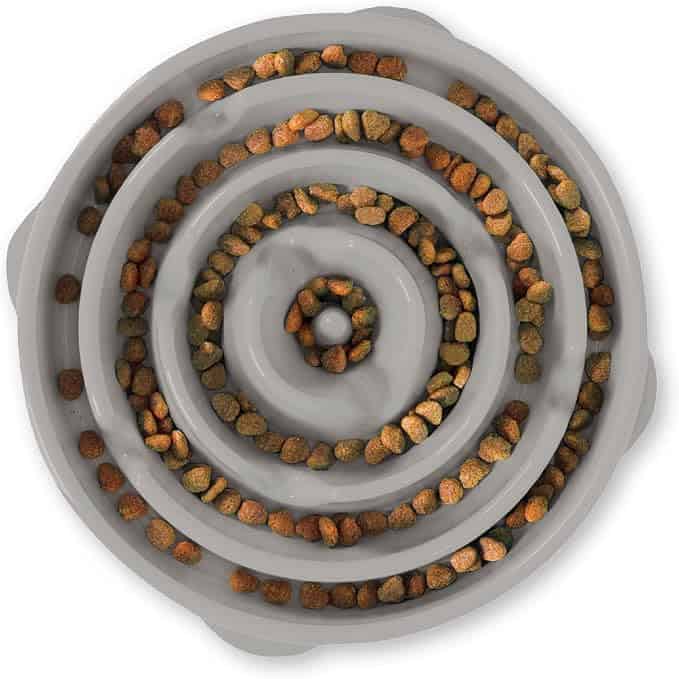
Outward Hound effectively invented the maze feeder, and its bowl remains the benchmark — a genuinely astonishing 130,000-plus reviews at 4.5 stars tell you everything about how well it works. The raised ridges break a bowl of kibble into dozens of little pockets, so your dog has to nose and lick each mouthful out rather than swallowing the lot in one go. A meal that took ten seconds now takes several minutes.
What makes it our top pick beyond the reviews is the range: it comes in different sizes and maze difficulties, so you can match it to a Chihuahua or a Labrador and to a dog that needs gentle slowing or a serious challenge. The food-safe plastic has a non-slip base to stop it sliding across the kitchen floor while your dog works.
It’s dishwasher-safe on the top rack and holds up to daily use. The only real limitation is that a very powerful dog can eventually pick a light plastic bowl up and tip it — if that’s yours, the heavier ceramic below is the fix. For almost everyone else, this is the one to buy.
- The original maze feeder — 130,000+ reviews at 4.5 stars
- Multiple sizes and difficulty levels
- Non-slip base; dishwasher-safe
- Reliably slows even determined gulpers
- Light enough that a big, determined dog can tip it — go ceramic if so
2. LE TAUCI Ceramic Slow Feeder
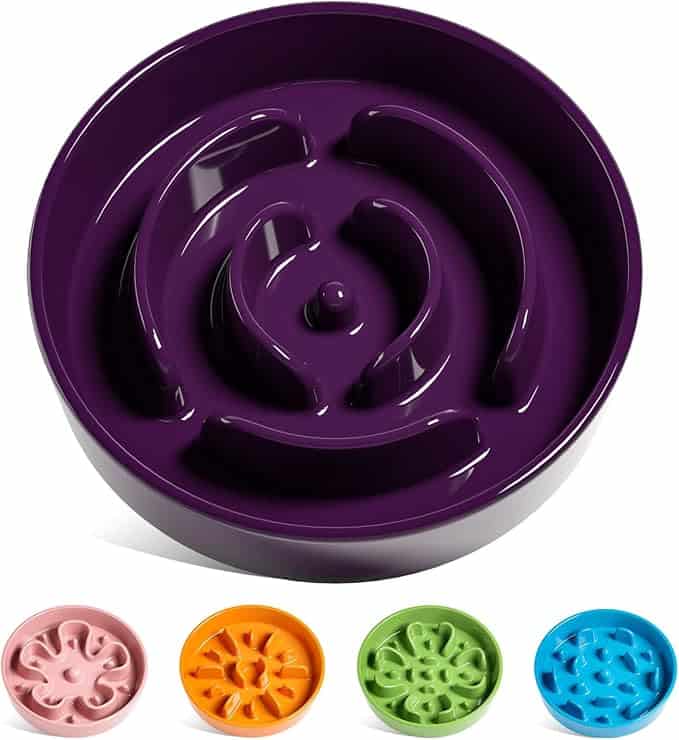
If you want to trade up, this LE TAUCI ceramic maze is the premium pick and, at 4.7 stars, the highest-rated bowl in this guide. Ceramic brings three advantages over plastic: it’s heavy enough that even a big dog can’t flip or slide it, it’s more hygienic (no scratches for bacteria to hide in), and it’s genuinely dishwasher-safe for a proper clean every time.
The glazed maze pattern slows eating just as effectively as the plastic bowls, and it looks far smarter on the kitchen floor — closer to a piece of tableware than a pet gadget. Owners of dogs with sensitive skin also like ceramic because, unlike some plastics, it won’t contribute to the chin acne that occasionally flares up with plastic bowls.
It’s the priciest bowl here and, being ceramic, it can chip or crack if dropped on a hard floor. But for a permanent, hygienic, no-slide feeder that’ll last for years, it’s well worth the extra. This is the one for households that want quality and don’t want to chase a bowl around the room.
- Highest-rated bowl here at 4.7 stars
- Heavy ceramic — can’t be tipped or slid
- Hygienic and fully dishwasher-safe
- Smart looks; kinder to plastic-sensitive skin
- Priciest here, and can chip if dropped on a hard floor
3. MateeyLife Slow Feeder
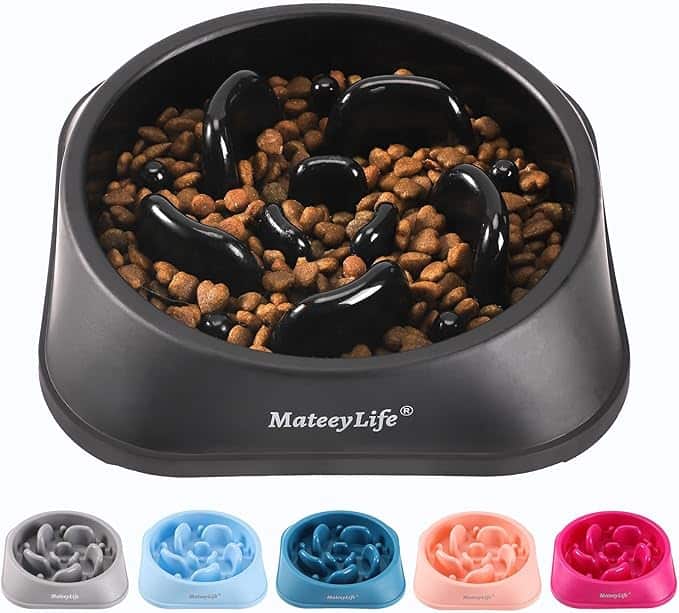
You do not need to spend much to slow a fast eater, and the MateeyLife bowl proves it — the cheapest option here by a mile, yet holding 4.6 stars from over 6,000 reviews. It’s a straightforward plastic maze feeder with an anti-choking design and a non-slip base, and it does the core job just as well as bowls costing three times as much.
For a first try — when you’re not yet sure how your dog will take to a slow feeder — it’s the obvious low-risk choice. It’s also perfect as a spare, or for a multi-dog home where you need several bowls without the bill mounting up. The maze is a sensible medium difficulty that suits most dogs.
Being budget plastic, it’s lighter and less rugged than the premium options, so a real bruiser of a dog might shift it around. But for the price, it’s outstanding value and the easiest way to see whether slowing your dog down solves the gulping and sick you’ve been dealing with.
- Cheapest bowl here — superb value
- 4.6 stars from 6,000+ reviews
- Anti-choking maze with a non-slip base
- Ideal as a first try or a spare bowl
- Light plastic — a very strong dog may push it around
4. YINEYA 4 Cups Slow Feeder
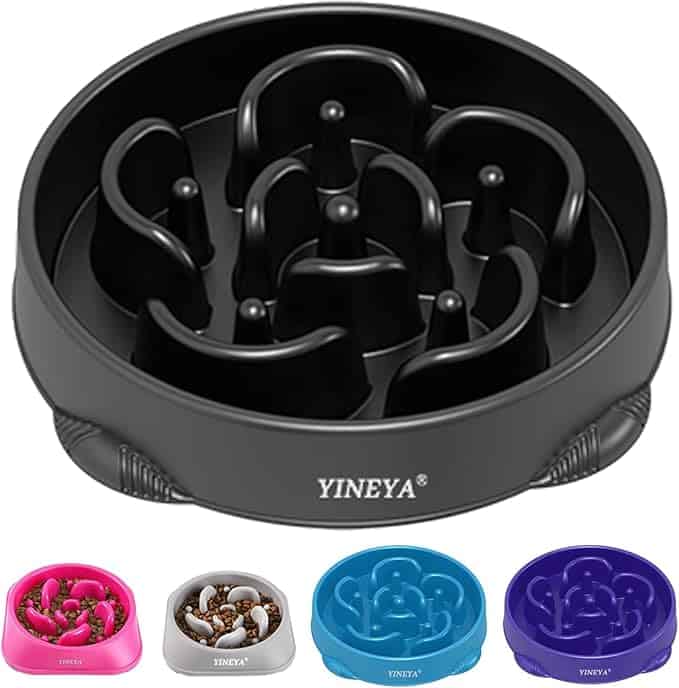
Big dogs need big meals, and a standard slow feeder can be too small to hold a Labrador or German Shepherd’s dinner. The YINEYA solves that with a four-cup capacity maze built for large breeds, rated 4.6 stars across 2,400 reviews. It holds a proper portion while still spreading it across enough ridges to slow a determined eater right down.
The larger footprint and deeper channels are designed for bigger muzzles, so a large dog can actually get at the food without frustration — a common problem when you put a big dog in front of a small, fiddly bowl. It has a non-slip base to cope with an enthusiastic large dog, and it’s easy to clean.
If you’ve got a small dog this is simply more bowl than you need, and the winner or budget picks are a better fit. But for large and giant breeds — exactly the deep-chested dogs where slowing gulping matters most — it’s the sensible choice.
- Large four-cup capacity for big meals
- Deeper channels suit large muzzles
- Non-slip base for enthusiastic big dogs
- 4.6 stars from 2,400+ reviews
- Too big for small dogs — choose a smaller bowl for them
5. Bloat Stop Slow Feeder
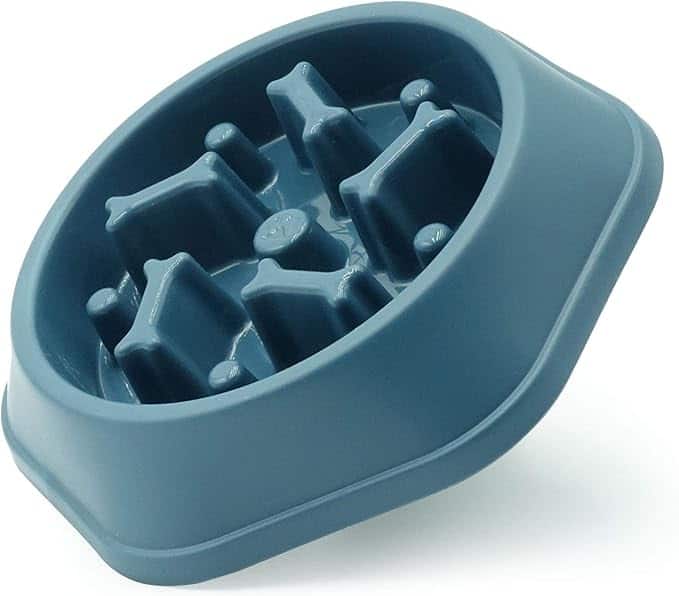
This tidy little maze bowl is the pick for small and medium dogs, and another genuine bargain at 4.5 stars from nearly 2,000 reviews. The swirl-pattern channels are sized for smaller muzzles, so a Cocker, terrier or French Bulldog can nose out their kibble without the frustration a big, deep bowl can cause — while still being slowed right down.
It does the anti-bloat job the name promises: by breaking the meal into a spiral your dog has to follow, it stops the frantic bolting that gulps down air. It’s light, dishwasher-friendly and cheap enough to buy two, which makes it a handy second bowl for a multi-dog household or to keep at the other end of the house.
As with the other budget plastic bowls, a powerful dog could shove it about, and it’s on the smaller side for large breeds. But for small and medium dogs — and as an inexpensive spare — it’s a smart, effective buy.
- Sized for small and medium muzzles
- Effective anti-bloat swirl design
- Cheap enough to buy a spare
- 4.5 stars from nearly 2,000 reviews
- Too small for large breeds; light plastic build
How to Choose a Slow Feeder Dog Bowl
Match the maze difficulty to your dog
Slow feeders come in different levels of challenge. Too easy and a clever, greedy dog clears it almost as fast as a normal bowl; too hard and a less patient dog gives up and walks away hungry. Start with a medium maze for most dogs, go simpler for puppies, seniors or flat-faced breeds who can’t reach into deep channels, and step up the difficulty only if your dog is breezing through.
Size and muzzle shape matter
Buy for your dog’s size: a big bowl frustrates a small dog, and a small bowl won’t hold a large dog’s meal. Flat-faced (brachycephalic) breeds like Pugs and French Bulldogs struggle with deep, narrow mazes and do better with shallow, wide ridges. If your dog can’t easily reach the food, they’ll either give up or tip the bowl.
Material: plastic, ceramic or stainless
Food-safe plastic is light, cheap and comes in the widest range of maze designs, but a strong dog can pick it up. Ceramic is heavy and hygienic and stays put, but costs more and can chip. Whatever you choose, wash it regularly — the nooks that slow your dog down also trap food, so a quick daily rinse and a dishwasher run keep it clean.
Why slowing your dog down is worth it
Fast eating makes dogs gulp air, which leads to burping, wind and sometimes bringing the meal straight back up. More seriously, vets link fast eating to a raised risk of bloat (gastric dilatation-volvulus), a life-threatening emergency most common in large, deep-chested breeds. A slow feeder is a simple way to reduce that risk factor and adds a little mental stimulation at mealtimes. If your dog often vomits after eating or seems bloated and distressed, speak to your vet.
Frequently Asked Questions
Do slow feeder bowls actually work?
Yes — for most dogs they dramatically slow eating, often turning a ten-second meal into several minutes. That reduces gulped air and the wind, gagging and vomiting that come with bolting food, and adds a bit of mealtime enrichment. The key is choosing a maze difficulty your dog will persist with rather than abandon.
Are slow feeders good for bloat?
They help address one known risk factor. Vets associate rapid eating with a higher risk of bloat (GDV), a serious emergency especially in large, deep-chested breeds, so slowing the meal down is a sensible precaution. It’s not a guarantee against bloat, and other measures matter too — if your dog shows a swollen tummy, retching without producing anything, or distress, treat it as an emergency and call your vet immediately.
Which slow feeder is best for a fast-eating puppy?
Choose a smaller bowl with an easier maze so your puppy is slowed without becoming frustrated, and pick a size that suits their little muzzle. As they grow and get the hang of it, you can move up to a larger or more challenging bowl. Always supervise a new puppy with any feeding device at first.
How do I clean a slow feeder bowl?
The same ridges that slow your dog trap food, so rinse it after meals and give it a proper wash regularly. Most plastic bowls are top-rack dishwasher-safe and ceramic ones are fully dishwasher-safe. Keeping it clean matters — leftover food in the channels can turn a healthy-eating bowl into a hygiene problem.
Can I use a slow feeder for wet food?
You can, though wet food smears into the channels and is messier to clean than kibble. It still slows eating and works well for enrichment. If you feed wet or raw, a smooth-glazed ceramic maze is easiest to wash out, and a quick soak loosens anything stuck.
Our Verdict
For most dogs, the Outward Hound Slow Feeder is the best slow feeder dog bowl in the UK — the original design, proven by more reviews than almost any pet product, and available in the right size for any dog. Want something that can’t be tipped? The LE TAUCI ceramic is the premium answer. On a budget, the MateeyLife bowl is unbeatable value, while big dogs want the YINEYA four-cup.
A slow feeder is one part of a happier, healthier mealtime. If your dog’s speed comes with wind or an upset tummy, our guides to the best dog foods for flatulence and the best dog foods for sensitive stomachs tackle the diet side. For more of the mental stimulation dogs love, pair it with a snuffle mat, and use tasty dog treats to make mealtimes and training more rewarding.