Feeding a puppy well in the first year sets them up for life, so the food in the bowl matters more now than at any other stage. A growing puppy needs a complete food built for growth — richer in energy, protein, calcium and the DHA that supports brain and eye development — not simply a smaller portion of adult food. Our top pick is the Harringtons Complete Dry Puppy Turkey & Rice — a complete, natural recipe from a trusted British brand with more than 6,700 reviews.
Below are five complete puppy foods covering every household: an all-round dry winner, a natural hypoallergenic pick, a grain-free option for sensitive tummies, a large-breed formula with controlled calcium for growing joints, and a budget-friendly wet food. There’s also a plain-English guide to feeding a puppy well — how much, how often, when to switch to adult food, and the one word on the bag that matters most.
Key Takeaways
- Best overall: the Harringtons Complete Dry Puppy Turkey & Rice — a complete, natural puppy kibble with no artificial nasties and 6,700+ reviews.
- Best natural/hypoallergenic: the Burns Hypoallergenic Puppy Lamb & Rice — a vet-formulated recipe with a short, honest ingredient list.
- Best grain-free: the Edgard & Cooper Puppy Grain-Free Duck & Chicken — a natural, gluten-free recipe for pups with a delicate digestion.
- Best for large breeds: the BETA Puppy Large Breed Turkey — controlled calcium and energy to support steady growth in big pups.
- Best value: the Pedigree Puppy Pouches — a complete, easy-to-find wet food that’s very kind on the wallet.
- Always choose a food labelled “complete” and formulated for puppies — only a complete puppy food is a full, balanced diet for a growing dog.
- Switch from the breeder’s food gradually over about a week to protect a sensitive young tummy.
The 5 Best Puppy Foods UK
1. Harringtons Complete Dry Puppy Turkey & Rice
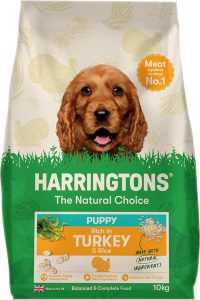
Harringtons has quietly become one of the UK’s most trusted everyday brands, and this turkey and rice recipe is the puppy food most owners should try first. It’s a complete food built specifically for growth — a full, balanced diet with nothing else needed — leading with turkey as a named meat and using rice for gentle, slow-release energy. There are no artificial colours, flavours or preservatives, and no beef, dairy or soya, which suits the many pups that do better without those common triggers.
With more than 6,700 reviews at a strong 4.6 stars, it has a track record that’s hard to argue with. Owners repeatedly mention settled tummies, shiny coats and clean bowls, and the recipe includes the extra protein and minerals a young dog needs to build bone and muscle. Turning the bag over shows a readable label led by named meat rather than vague “meat and animal derivatives” — exactly what you want when you’re feeding a growing pup several times a day.
The large bag is where it earns its keep: the per-meal cost undercuts almost every premium rival while the quality stays genuinely good, which matters when a hungry puppy empties a bag surprisingly fast. For most healthy puppies this is the sensible default — a clean, complete, well-priced kibble that ticks every box without asking you to remortgage. It’s our best overall puppy food for good reason.
- Complete puppy recipe with named turkey
- 6,700+ reviews at 4.6 stars
- No artificial colours, flavours or preservatives
- Excellent value in the big bag
- Very large or giant breeds may do better on a large-breed formula
2. Burns Hypoallergenic Puppy Lamb & Rice
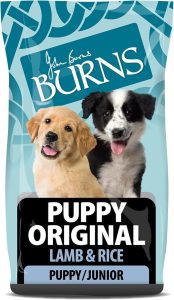
Burns was founded by a vet, and it shows in the philosophy behind this food: fewer ingredients, a moderate protein level, and nothing that isn’t earning its place. This puppy recipe pairs lamb with brown rice in a hypoallergenic, complete formula that’s designed to be gentle on developing digestions. If your pup came from the breeder with a slightly delicate tummy, or you simply want a short, honest ingredient list you can actually read, it’s an excellent place to start.
It carries a 4.6-star rating from over 480 reviews, and owners of sensitive pups tend to rate it highly for firm stools and calm digestion. The “hypoallergenic” here means it leaves out the common triggers of beef, dairy, wheat and soya, so it suits dogs that react to richer supermarket foods. Many pups also settle on a slightly smaller portion than they would of a cheaper kibble, which quietly narrows the price gap over time.
The catch is cost: a vet-formulated recipe like this asks more per bag than an everyday food, and it comes in smaller sacks than the big-breed bags elsewhere in this guide. But for a young dog with a nervous digestion — or an owner who wants a clean, considered recipe — it’s a lovely food to feed. For a diagnosed allergy, though, your vet remains the right first call; our guide to the best dog foods for sensitive stomachs is a useful companion.
- Vet-formulated, hypoallergenic recipe
- Short, readable ingredient list; no beef, dairy, wheat or soya
- 4.6 stars from over 480 reviews
- Gentle on delicate young digestions
- A premium price in smaller bags than our value picks
3. Edgard & Cooper Puppy Grain-Free Duck & Chicken
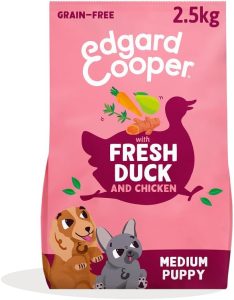
Edgard & Cooper has built a following on fresh, honestly-labelled recipes, and this grain-free puppy food is a natural choice for pups with a sensitive digestion. It’s built around freshly-prepared duck and chicken with sweet potato instead of grains, and it’s gluten-free and free from artificial additives. Grain-free won’t suit every dog — plenty digest grains perfectly well — but for a pup that seems unsettled on a standard kibble, a simple grain-free recipe is a sensible thing to try.
It holds a solid 4.4-star rating from over 360 reviews, and the ingredient list is refreshingly transparent, with named meats up top and no vague “derivatives”. The kibble is small and easy for little mouths, and the duck base tends to go down well with pups that turn their noses up at chicken-everything. It’s a complete food, so it’s a full, balanced diet for a growing puppy on its own.
It sits at the premium end per kilo and comes in smaller bags than the big-breed sacks here, so it’s more of a considered buy than a bottomless everyday default. But if a delicate tummy is your main concern, it’s one of the nicer natural recipes around. Worth remembering that grain-free isn’t automatically healthier for every dog — our guide to the best grain-free dog food explains when it genuinely helps and when it’s simply a preference.
- Grain-free and gluten-free with freshly-prepared duck and chicken
- Transparent, easy-to-read labelling
- Small kibble that suits little mouths
- 4.4 stars from over 360 reviews
- Premium price per kilo, in smaller bags than our value picks
4. BETA Puppy Large Breed Turkey
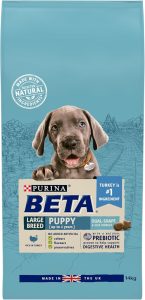
Big puppies aren’t just small puppies scaled up — they grow for longer and carry more weight on joints that are still forming, so their food needs to be managed carefully. This BETA large-breed recipe is built for exactly that: a complete puppy food with controlled calcium and a sensible energy level, designed to support steady, even growth rather than the rapid spurts that vets and the Kennel Club warn can stress a big pup’s developing joints. Turkey leads the recipe, and it’s free from artificial colours and flavours.
At 4.6 stars from over 1,800 reviews, it’s the best-proven large-breed option in this guide, and the big bag suits owners of Labradors, Retrievers, German Shepherds and other sizeable pups who get through food quickly. Controlled growth is one of the simplest things you can do for a large-breed puppy’s long-term joint health, and a purpose-made formula takes the guesswork out of it.
The one thing to note is that this is a formula for a specific job — a big, fast-growing pup — rather than a one-size-fits-all food, so a toy or small breed doesn’t need it. Match it to the dog in front of you and feed to the guide for their expected adult weight. Larger breeds also stay on puppy food for longer, often past their first birthday, so don’t rush the switch to adult food.
- Controlled calcium and energy for steady large-breed growth
- Named turkey; no artificial colours or flavours
- 4.6 stars from over 1,800 reviews
- Big bag suited to hungry large-breed pups
- A large-breed formula — toy and small breeds don’t need it
5. Pedigree Puppy Pouches (Chunks in Jelly)
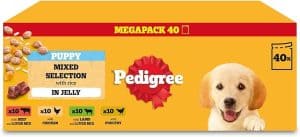
Sometimes you just want a good, complete puppy food at a price that works when you’re feeding several small meals a day — and this Pedigree multipack delivers. The pouches are a complete puppy food, so they’re a full daily diet on their own, formulated for the extra energy and development a growing dog needs. The soft chunks in jelly are gentle on soft young teeth and easy for little mouths, and the four flavours keep mealtimes interesting for a fussy pup.
At 4.7 stars from over 500 reviews, it’s a well-liked, widely-available option, and it’s remarkably cheap — ideal when a puppy is eating little and often and getting through pouches quickly. Wet food also brings a welcome hit of moisture, which suits pups still learning to drink enough, and its softness makes it easy to mix with a splash of warm water for very young puppies just weaning onto solids.
It isn’t a natural or grain-free recipe like our premium picks, but not every puppy needs that — plenty thrive on a straightforward, tasty complete food, and many owners feed wet and dry together. For budget-conscious households and hungry litters, it’s the value champion here. If you’re weighing up the true cost of those first months, our breakdown of the cost of owning a dog puts puppy food in context, and our guide to the best wet dog food covers the rest of the range.
- Complete puppy food at the best value in this guide
- Soft chunks in jelly, kind on developing teeth
- Four flavours and extra moisture for fussy young pups
- 4.7 stars from over 500 reviews
- Not a natural or grain-free recipe like our premium picks
How to Choose the Best Puppy Food
Why puppies need a puppy-specific “complete” food
Growing puppies have very different needs from adult dogs. They’re building bone, muscle and brain at speed, so they need more energy, more protein, and carefully balanced calcium and phosphorus for healthy skeletal growth, plus DHA — an omega-3 fatty acid that vets link to brain and eye development. That’s why a food labelled for puppies or junior matters: it’s formulated for growth, not maintenance. Just as important is the word “complete“. A complete food provides everything your puppy needs from that food alone, while a “complementary” food (many toppers, treats and mixers) is only meant to be fed alongside something else. Every food in this guide is complete.
Large breeds are a special case
If your puppy will grow into a large or giant breed — a Labrador, German Shepherd, Great Dane and the like — a standard puppy food can actually be too rich. Too much energy and calcium encourages growth that’s faster than the joints can safely keep up with, which vets and the Kennel Club associate with orthopaedic problems later on. A large-breed puppy formula, like the BETA pick above, controls calcium and energy to encourage slower, steadier growth. Big pups also finish growing later, so they stay on puppy food for longer than small breeds.
How much and how often to feed
Puppies have small stomachs and big appetites, so they eat little and often. As a rough guide, most pups have four meals a day from weaning to around four months, dropping to three meals until about six months, then two meals a day from there on — a routine you can keep for life. Always feed to the guide on the pack for your puppy’s expected adult weight, not their current size, and adjust to body condition: you should be able to feel the ribs without a thick layer of fat. Puppy obesity is a growing problem the PDSA regularly flags, and keeping a pup lean protects those developing joints.
Switch foods gradually
When you bring a puppy home, find out what the breeder was feeding and keep them on it for the first few days, however tempting it is to change straight away — a new home is stressful enough for a young tummy. When you do switch, do it slowly: mix a little of the new food into the old and increase the proportion over about seven days, so their digestion has time to adjust. A sudden change is one of the most common causes of puppy diarrhoea, and it can make a perfectly good food look as though it “didn’t agree” with them.
When to switch to adult food — and when to see your vet
Most dogs are ready to move onto adult food at around 12 months, but it depends on size: small breeds may be done growing by 9–10 months, while large and giant breeds often stay on puppy food until 12–18 months. Make that change gradually too. And while a good diet does a lot, it can’t do everything — if your puppy has persistent diarrhoea or vomiting, isn’t gaining weight, or has a suspected allergy, see your vet rather than simply switching foods, and follow their guidance on any prescription diet. No puppy food can cure a medical condition, whatever the marketing suggests.
Frequently Asked Questions
Do puppies really need special puppy food?
Yes. Puppies grow rapidly and need more energy, protein and carefully balanced calcium than adult dogs, plus DHA for brain and eye development. A food labelled for puppies or junior is formulated for growth, whereas adult food is formulated for maintenance. Feeding a complete puppy food until your dog finishes growing is the simplest way to get that balance right.
How much should I feed my puppy?
Start with the feeding guide on the pack, which is based on your puppy’s expected adult weight and age, then adjust to their body condition. Split the daily amount across several small meals — roughly four a day when very young, reducing to two by around six months. If your pup is gaining too much or too little, tweak the amount and check with your vet if you’re unsure.
Can I feed my puppy adult dog food?
It’s best not to as their main diet. Adult food doesn’t have the extra energy, protein and balanced minerals a growing puppy needs, so relying on it can leave gaps at a crucial time. Stick to a complete puppy or junior food until your dog has finished growing, then transition gradually onto an adult recipe.
When should I switch my puppy to adult food?
Around 12 months for most dogs, but it varies with size. Small breeds often finish growing by 9–10 months, medium breeds around a year, and large or giant breeds not until 12–18 months. Make the switch slowly over about a week, mixing increasing amounts of adult food into the puppy food, and follow your vet’s advice if you’re unsure for your breed.
Is wet or dry food better for puppies?
Neither is universally better — many owners feed both. Dry kibble is convenient, good for teeth and cheaper per meal; wet food is softer on young teeth, more tempting for fussy pups and adds moisture. What matters most is that whatever you choose is a complete food formulated for puppies. Softening dry kibble with a little warm water can also help very young pups just weaning onto solids.
Our Verdict
For most homes, the Harringtons Complete Dry Puppy Turkey & Rice is the best puppy food you can buy — complete, natural, free from the usual nasties and backed by thousands of happy owners at a genuinely fair price. If your pup has a delicate digestion, the vet-formulated Burns Hypoallergenic Puppy is a lovely gentle choice, and for a grain-free recipe the natural Edgard & Cooper Puppy is well worth a try.
Raising a big pup? The BETA Puppy Large Breed formula protects growing joints with controlled calcium, and for easy, affordable feeding the complete Pedigree Puppy Pouches are the value champion. Whichever you pick, choose a complete puppy food, transition slowly, and feed to body condition — and for any persistent tummy trouble or suspected allergy, your vet comes first. As your pup grows into a steadier adult, our guides to the best dry dog foods and to when puppies calm down will help you plan the next stage, and a little groundwork from our puppy training guide makes those first months far smoother.